
Pisgah Legal Services brings immigration to forefront
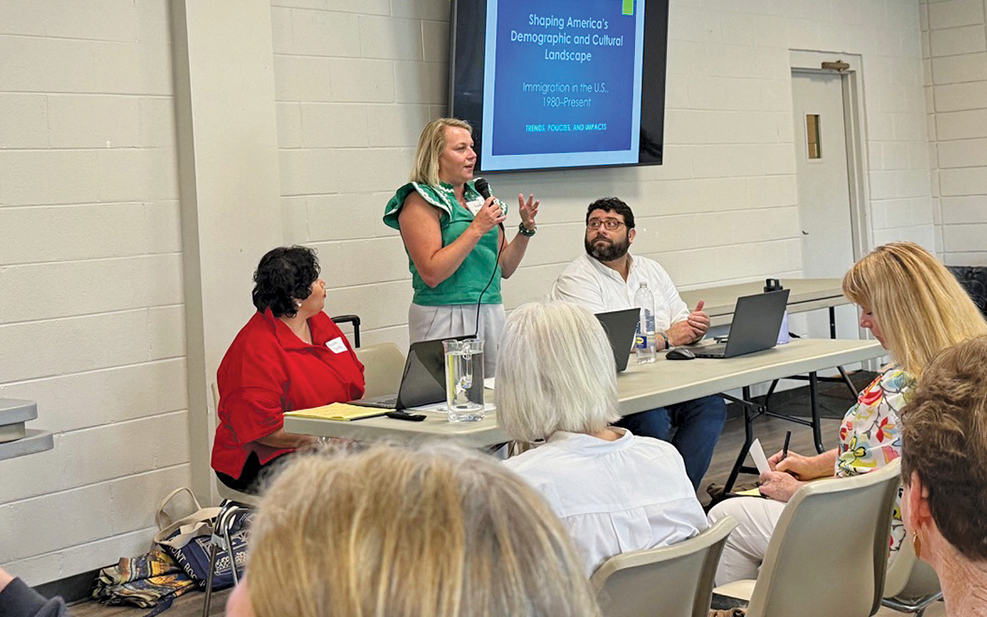
Immigration Attorney Leonel Gonzalez and Faviola Olvera of the Community Care Clinic talked about the complexities of immigration in the United States, which is currently home to 45 million immigrants.
Hosted by Pisgah Legal Services, the conversation at Highlands Recreation Park highlighted various aspects of immigration policy and the challenges that many immigrants face under the legal framework that governs their status.
Olvera dove into the history of immigration in the country, tracing back to the 1980s, when the modern perception of the topic began to take shape with the Immigration Reform and Control Act of 1986. The Act made it illegal to hire undocumented workers, which in turn provided a pathway to legalization for millions of immigrants.
“This bill was instrumental in shaping what immigration is today because it was the first time that it was made illegal to hire undocumented workers,” she said. “So, the purpose of this bill was basically to put some enforcement behind our immigration system.”
Following this, the Immigration Act of 1990 increased annual caps and diversified the visa program, leading to a surge of immigrants from Asia, Africa and former Soviet states. This resulted in 1.5 million newcomers a year, on average.
However, immigration policy took a turn after the events of 9/11 when, Olvera said, the country saw a security-focused policy shift, leading to the creation of the Department of Homeland Security and U.S. Immigration and Customs Enforcement, and increased visa and refugee scrutiny.
“When we started to militarize the border in the early 2000s, we also saw a larger shift of family units moving to the U.S. So before people pretty much go back and forth, they were undocumented, they worked for a season or two and they go back home,” she said.
A portion of the discussion focused on the increasing number of asylum seekers from Central America, driven by violence, political instability and natural disasters. The complexities of the asylum process were highlighted, including the requirements to apply within a year of arrival and the high denial rates in immigration courts.
Olvera said that previously an executive order was passed to allow young people that arrived before 2007 to have temporary legal status. The qualification was that the individual had to have been brought over by parents or guardians and did not have any type of legal documentation.
“Currently, there are no new cases being accepted, but we still have over half a million people that benefited from this program,” she said.
Gonzales highlighted some of the legal pathways for immigrants, which include Deferred Action for Childhood, or DACA. This aims to protect eligible young adults who were brought to the country as children from deportation and offers them temporary work authorization that can be renewed.
Reflecting on the presentation, retired attorney Staci Holtzman expressed surprise over some of what Olvera and Gonzales shared.
“I’m surprised that with the DACA program that there’s no path to citizenship. Once you’re in that DACA program, it’s just a status that you have to renew every two years and it’s very expensive to renew. It’s over $500 to renew,” she said.
Additionally, there are also U Visas for survivors of violent crimes alongside Temporary Protected Status. However, Gonzales also noted the limitations of these programs, such as the lack of pathway to citizenship for DACA recipients and the lengthy wait time for U Visas, which can take up to 18 years to process.
The discussion also touched on the importance of educating immigrants about their rights, particularly in interactions with law enforcement.
“If law enforcement asks you questions, you have a right to remain silent and to talk to an attorney as well. Those are the very basic facts we’re providing to the community,” Gonzales said. “By virtue of being in the United States, you have protections by the Constitution, that is the law of the land.”
Gonzales added the importance of community organizations and legal services in supporting immigrants, which can provide representation and advocacy for those navigating the immigration system.
However, Gonzales also highlighted the role the community can play in helping immigrants, especially in a tightly-knit community like Highlands.
“What I would do is if someone is getting arrested by immigration officers, I would try to see if I can find the person who got arrested and then get in contact with the family and provide the videos to the family so they can share that … with their attorney,” he said.
While Gonzales said he doesn’t see a long-term immigration solution formulating in the near future, he said now is the time to be vocal.
“I talked to a chief of police in Western North Carolina and he said, ‘You know, I listen to my constituents and my constituents are business owners, farm owners and people that employ people,’” he said “I think this is a good time to be civically engaged and let people know.”