
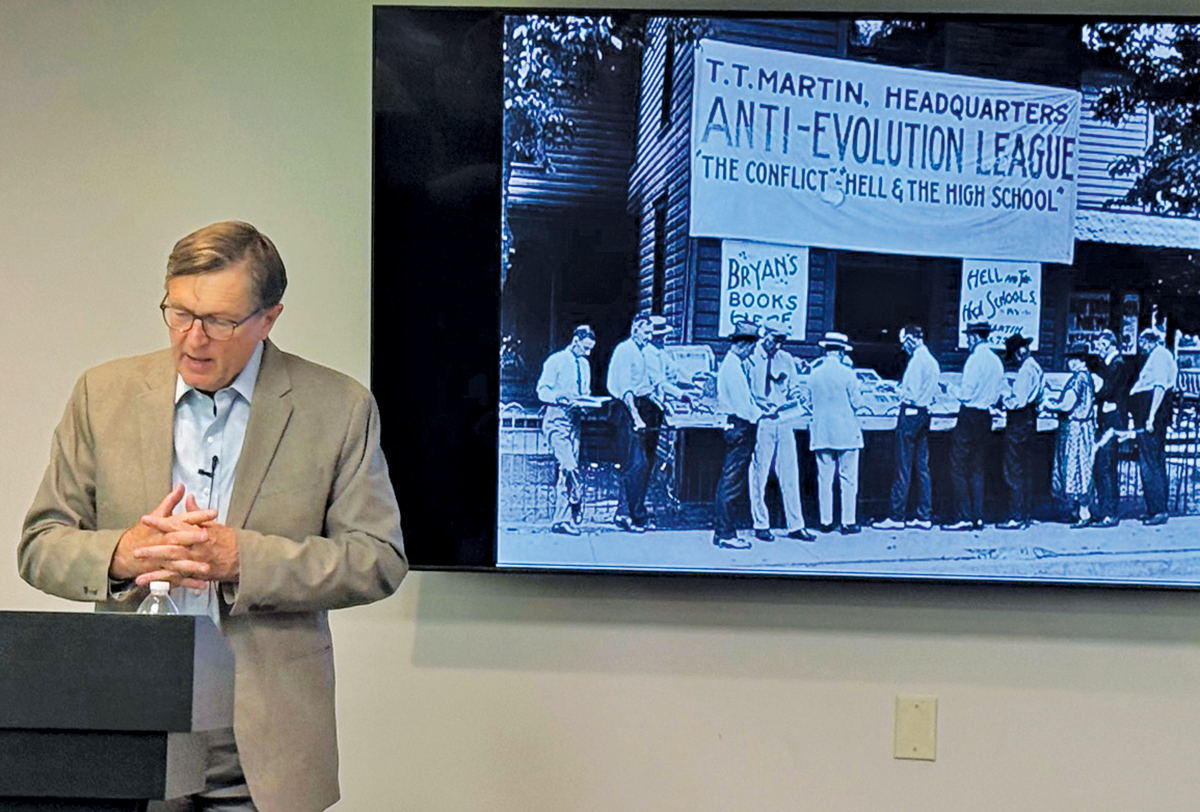
A hundred years after its verdict, the Scopes Monkey Trial, also known as Tennessee v. John Thomas Scopes, remains a cultural touchpoint surrounding the teaching of evolution in schools. The Center for Life Enrichment held a discussion last week to tie this historic trial to modern topical issues, led by guest speaker Edward Larson.
Inviting Larson to speak about the trial, the discussion aimed to tie the historic court case in with modern culture war issues that currently grip the nation. With the hundred-year event itself similarly emerging against a backdrop of significant societal changes.
Larson said the trial was characterized by a perceived rise in secularism and a challenge to traditional religious beliefs, which saw division between modernists, who sought to reconcile the faith with scientific understanding, and fundamentalists who adhered to Biblical literalism.
“In 1922, fundamentalists began lobbying for laws against the teaching of Darwinian theory of human evolution in public schools, leading to the enactment in Tennessee of the first set statute in March of 1925, a little over a century ago,” said Larson.
The trial itself was sparked by the enactment of the Butler Act in Tennessee, which made it illegal to teach human evolution in public schools. Larson added this law was part of a broader movement among fundamentalists to remove evolutionary theory from educational curricula.
“All those involved viewed it as a friendly test case of the controversial law and a ploy to publicize it,” he said.
William Jennings Bryan became a prominent political figure and the face of the anti-evolution movement. Larson said Bryan argued that teaching evolution undermined moral values and societal norms, claiming that Darwinian theory led to societal decay and even warfare.
“Those times, the early 1920s, were disorienting for many Americans. Whether true or not, Americans perceived their country was becoming more secular during what became known as the ‘Roaring’20s,’” he said.
However, on the opposing side was Clarence Darrow, a renowned defense attorney who represented Scopes. His strategy was to challenge the validity of biblical literalism and to advocate for academic freedom, famously questioning Bryan during the trial.
“It was the first broadcast trial in American history, as far as I know. It later became the subject of Broadway plays, Hollywood movies and Nashville songs,” he said. “Clearly, Scopes remains the best-known misdemeanor trial in American history.”
Despite the high-profile nature of the trial and the media attention it gained, Scopes was found guilty of violating the Butler Act and was fined $100. However, the trial itself had far-reaching implications, beyond its overall verdict. It ignited a national conversation about the role of religion and science in education.
In subsequent decades, the debate over evolution continued to evolve, with various legal battles and educational policies emerging within the country. The introduction of intelligent design as an alternative to evolution in school curricula further complicated the issue, leading to court cases that questioned the constitutionality of teaching religious concepts in schools.
“Formal and informal state and local restrictions against evolutionary instruction multiplied nationwide after Scopes was convicted in the law. As a result of these restrictions, all across the country, local or state publishers all but deleted the subject from biology textbooks,” he said.
Larson said this remained the case until the 1950s during the Cold War, when concerns about the quality of American science education led to infusion of federal funds for new science textbooks.
“By then, the synthesis of Darwinian selection and modern genetics had established evolution as the core concept in biology,” he said.
While the Scopes trial was a century ago, Larson said it remains part of a larger cultural conflict that has persisted for over a century. By highlighting this historical perspective, Al Pearson of the Center for Life Enrichment’s board of directors, said it aims reflect the divisiveness of the modern day.
“That’s why the talk was pitched. It was to carry forward the tensions that were unveiled in the Scopes trial and carry them forward to the contemporary era,” he said.
Adding to this, Pearson said he hopes the takeaway from the presentation will lead to connections of other divisive cultural issues, and how those are responded to in the modern day.
“I hope that the talk will get a clearer picture for the way politics are working, and we’re not just talking about evolution. We’re talking about a lot of cultural issues that are present,” he said. “Polarization exists along a number of issues. I hope people get some idea about the strategies that sort of restrict curriculum content,” he said.
- Kevin McCall
reporter@highlandsnews.com