

In a special called meeting on Aug. 24, the Town of Highlands Board of Commissioners reached a verbal consensus to enforce all its residential ordinances, which bans short term rentals in R-1.
Since that time, an opposing group in support of STR’s said that the town acted too quickly and needed to do an economic evaluation before banning STR’s. The opposing group consists of Debi Bradshaw Martin, Caroline Ragsdale, Will Pichard, Becky Blakeney, Chris Rideout, David Bee, Julia Weller, Chris Weller, Kristy Jones-Favalli and Jennifer Huff.
“The town conducted no economic impact study to amass the detrimental economic fallout this will have to Highlands, to Macon County, and to our locals who rely heavily on over 400 STR’s to put food on the table,” The group posted on its website, savehighlands.net. “We are fighting for the people who will lose jobs and the property managers who will lose companies. We are fighting for the businesses who have come to rely on tourism as a means to survive. We are fighting for those whose retirement plans counted on this revenue and for those who spent their life savings. It is also about the older owners whose sole income is their rental revenue. The foreclosures, the decline in property values, and the lost tax revenue will be devastating.”
One big topic brought up by the opposing group was the occupancy tax that the Chamber of Commerce receives from STR’s and hotels.
Occupancy taxes, also commonly known as lodging tax, room tax, hotel tax, or tourist tax, are taxes that hosts and property managers are required to collect from guests then pay to state and local tax authorities when operating a short-term rental.
In 2017, the chamber received $566,855.58 from occupancy tax. The number steadily increased over the next four years with $628,782.58 received in 2018, $665,941.38 in 2019, $755,964.54 in 2020 and $1,324,740.16 in 2021. The increase in money from 2020 to 2021 was not because of STR’s, but because of the COVID-19 pandemic.
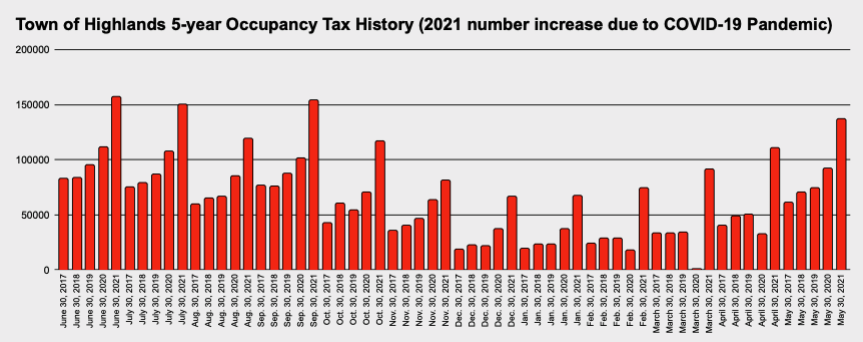
Highlands Chamber of Commerce executive director Kaye McHan estimated that approximately 40 to 50 percent of the occupancy tax budget comes from short term rentals.
“We have guessed at times that it is about 40 to 50 percent, but we just don’t know,” McHan said. “For a long time, we did not even receive this money. Before AirBnB and VRBO, we had people that would rent out their homes for less than 90 days. They would still have to pay occupancy tax, but it would be up to the owner if they would even send it in. Once AirBnB and VRBO came around, they eventually started collecting it. We trying to figure out now, if the ban were to go through, how much money would we lose.”
According to legislation passed in 1983 by the North Carolina General Assembly, occupancy tax must be used within five categories: destination promotion, tourism related expenditures, which includes uses varying from staging festivals and events to providing some municipal services in beach towns, funding or debt support for tourism related capital projects such as convention centers and arenas or visitor attractions, beach renourishment and general fund revenue and other non-tourism uses.
In Highlands, McHan said they put together a budget for all of the occupancy taxes collected: 20 percent of the funds go to grants and scholarships, 19 percent goes to local events, 16 percent goes to contractors, 14 percent goes to staff, nine percent goes to a destination marketing firm, seven percent goes to the technology platform, five percent goes to traditional media, five percent goes to the Welcome Center, four percent goes to administrative expenses and one percent goes to branding and PR.
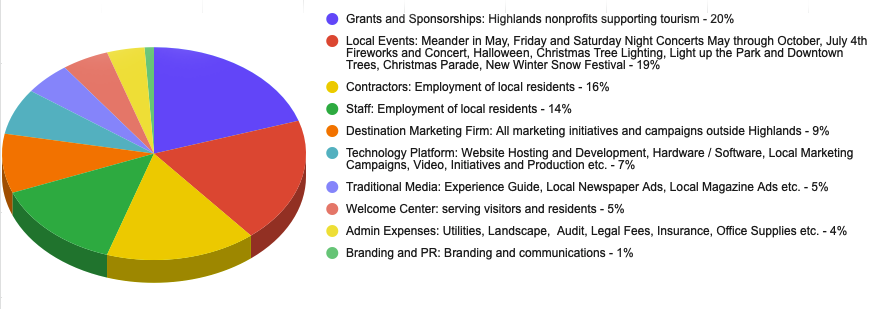
“We give a lot of money to non-profits in the area,” McHan said. “We do that because they often bring in tourists. For example, The Bascom, the Performing Arts Center or the Historical Society. We set aside 19 percent for local events, such as Meander in May, all of our concerts, our Fourth of July fireworks, the Christmas tree lighting and we also pay for some of the lighting of trees downtown and the Christmas parade. Imagine no Christmas parade, concerts or no support for our nonprofits. That’s where the money is going, and the sad part is most people don’t realize that.”
McHan made it clear that the Chamber will not pick a side in the situation of STR’s.
“We are not going to take sides on this,” McHan said. “We also live here, just like everybody else, and we do understand the residents do have some problems and we are really sad that it is our tourists that are causing problems. We sympathize with them, but at the same time, we want to keep our town healthy.”
Bill Long, President of the Dog Mountain Property Association, agreed that occupancy tax does help the town, but disagrees that the percentage of STR’s in the occupancy tax is 40 to 50 percent.
“I am pleased to know what the occupancy tax is and that the chamber and the town benefits from that,” Long said. “Respectfully, from my discussions with town commissioners, the mayor and Macon County, I think the claim that they are making a guess that 40 to 50 percent of the occupancy tax comes from short term rentals is inaccurate. That claim is a shear guess. They have no idea. I’ll go back to the conversation that I had with Macon County. They said that they do not provide breakdowns for short term rentals to the chamber or to the town.”
The amounts that are in the occupancy tax are lumped together from hotels, motels, short term rentals and private homes.
“The number is dependent on the increases and decreases of room rates, occupancy rates, rooms that are available, hotel and motel rooms that are available and the rates of those rooms,” Long said. “So, I think to try and break it down when Macon County said they can’t, is really disingenuous on what that guess could be.”
Long said that the state requires all STR owners to pay a retail tax to the state if they rent their homes for less than 90 days.
“For those that have an STR in R-1, some in R-2 and R-3, that are renting out for less than 90 days, and are doing so illegally, the town confirmed that, are having to pay that tax,” Long said. “Just because you’re getting additional revenue, from a tax on an illegal service, doesn’t make it good, or right, or better. It’s as if the mob that transported liquor in the 1930s paid the small towns and sheriffs to look the other way. The revenue might have been good for the town and good for the sheriff, but is it the right thing to do? The town has made that decision and they have made the decision and agreed that the code said it is illegal. If we need the revenue, then we need to build the rooms and build the revenue in legal areas.”
Another point that the group in support of STR’s that Long said he disagrees with is that the town’s businesses and restaurants will see a decrease in sales when the town bans STRs.
“If I am staying in a hotel, I am more likely to spend that money on going out to restaurants because I don’t have a built-in kitchen, like STRs,” Long said. “I know this because they are eating beside my house. They are out on the deck drinking beer that they bought at the grocery store. I would argue that they are spending fewer dollars than they would spend staying at a hotel or motel. I do agree that the extra tourism dollars are good, and I am pro-business, but again, why would we want to encourage this illegal activity.”
Roughly 60 percent of business owners indicated that more VRBO’s and short-term rental properties would be good for their business, according to a survey done for the new Highlands Comprehensive Plan.
“There has to be some sort of balance,” Jake Petrosky, Planning Manager with Stewart Inc., said at a specially called meeting of the town planning board in July. “We don’t want Highlands to become Charleston, where the entire town is now essentially short-term rentals, and nobody lives there full time. But at the same time, there is a reason VRBO’s are so popular, they make money for the property owner, and they bring in tourism dollars across several business sectors.”
Petrosky added that the state of North Carolina, via legislation, has been clear that towns cannot force short-term rental property owners to register, pay any kind of additional tax above and beyond what other businesses pay, or cap the number of short-term rentals in a location.
He did offer a few possible solutions to curb the influx of short-term rentals in the future.
“Some of these are low hanging fruit, like enforcing the town’s current noise ordinance, speed limits and sanitation ordinances,” Petrosky said. “Short-term rentals must abide by town rules just like everyone else. Secondly, there is the possibility of putting a minimum stay requirement in place and mandating that short-term rentals can’t be rented for less than three days, five days, a week, whatever the town board decides.”
Petrosky added that there is potential for conditional zoning within the R-1 residential zones to exclude VRBO’s, but conditional zoning is complicated and often requires unanimous consent from a large group of adjacent property owners to accomplish.
“HOAs still have the power to make their own covenants to govern their own neighborhoods, so they can vote to not allow short-term rentals,” Petrosky said. “But once short-term rentals are in place and operating there aren’t really any outlets to stop them.”
Petrosky informed the planning board that the conversation surrounding short-term rentals is ongoing and the comprehensive plan can be amended prior to adoption if the town decides to put any restrictions in place.
With Old Edwards Inn having a heavy business presence in the wedding industry, OEI president Richard Delany said the majority of their wedding guests stay in STR’s in Highlands.
“It would be hard to quantify the exact percentage, but I can tell you the majority of our wedding guests stay in STR’s and other hotels in Highlands. That equates to thousands of visitors a year which Highlands simply lacks the Hotel room inventory to accommodate. Most of those guests at some point over the weekend spend money in all the shops, bars and restaurants in town. And these guests come back to Highlands to visit over and over again after discovering this great town, with some of them deciding to buy second homes in the area. It also expands the demographics of our visitors and residents thus contributing to the sustainability of our community.”
Delany said the economic effect banning STR’s in residential zoning would be a loss of millions of dollars in Highlands.
“It would affect us, our employees’ livelihoods, and many of the other businesses in town dramatically if we were to lose that business,” Delany said. “I cannot stress enough the significant negative economic impact this would have on so many people if this continues, but it is easily in the millions of dollars. And do not forget the actual STR owners who have invested huge amounts of money into these properties, in many cases dramatically improving the appearance of these houses. And then there is the sales tax and occupancy tax implications to consider. So many factors that seem to have been totally ignored or just not considered.”
As far as OEI employees, Delany said none rely on STR’s for housing.
Though the UDO defines a short-term rental for any rental that rents for less than 90 days, according to the 2020 North Carolina Visitor Profile, overnight visitors usually only stay for 3.6 nights, resident overnight visitors stay for 2.8 nights, out of state overnight visitors stay for 4.1 nights, leisure overnight visitors stay for 3.6 nights and business overnight visitors stay for 3.4 nights.
Out of those visitors, almost 40 percent of out of state travelers stay in a private home using short term rentals. Almost 50 percent of N.C. residents stay in a private home.
- By Christopher Smith