
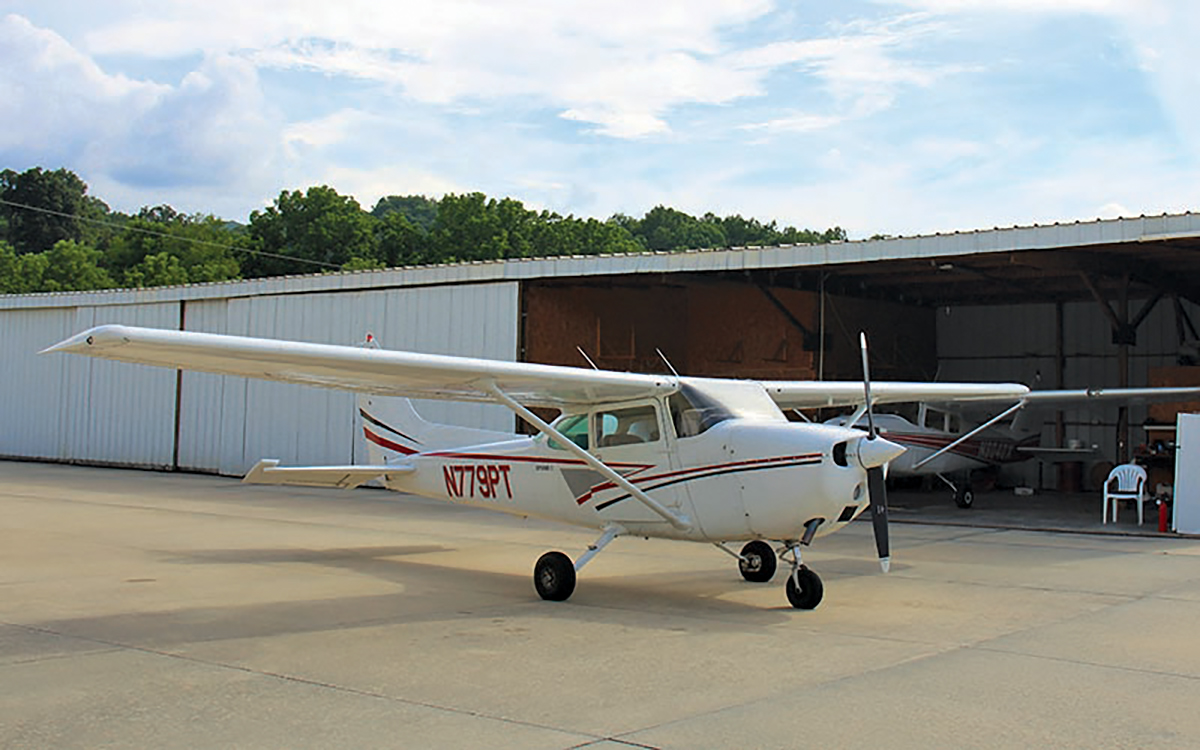
Beyond being a hub for private planes, Macon County Airport leaders say the airport is a potent economic driver for the county.
According to information from the N.C. Department of Transportation’s state of aviation report released in January 2025, Macon County Airport creates 90 jobs, $7,340,000 of personal income, $1,274,000 in state and local taxes and $16,030,000 in economic output.
Airport manager Sabrina Crone and Airport Authority board chair Gary Schmitt say this economic activity is divided among the airport’s private and commercial uses.
“We have basically 30 hangars full,” Schmitt said, “and they’re basically all private pilots. They come out at different times and fly their airplanes. I mean, the airplanes don’t just sit there in the hangars for years at a time … There’s a lot of instruction that goes on out here … mountain flying is a different animal. And a lot of people like to learn to fly in the mountains, so they have to come to a place like this.”
“We have several people that are here on vacation or something, they’ll call us and say, ‘Hey, can I have an instructor go up to teach mountain flying?’ It’s something you can’t get everywhere,” Crone said. “And that doesn’t include people in Jackson County that’ll fly in a lot, because they like practicing over here and they like flying over here.”
Crone said being able to fly in the mountains is not an official requirement for a commercial license, but the skill is one that will enable pilots to advance further in their careers, and so the capacity of Macon County to practice those skills makes it an attractive location all across Western North Carolina. While additional airports are located in Jackson and Cherokee counties, Schmitt said a lot of air traffic at the Macon County Airport comes from people with second homes in Highlands or those traveling to Cherokee, either owning the planes themselves or chartering flights.
Crone said from July 1 to 29, the airport reported 76 business jets coming in – noting that their system had gone down for the Fourth of July weekend, which was especially busy. “So 76 plus,” she said.
Private companies also fly employees and executives to the area to host retreats.
“We have some companies that come and they’ll rent a place up in Highlands,” Crone said, “or the president … owns a house up there, and so they’ll fly in all their workers and do a big conference.”
Truist Financial and NetJets, a private jet company, utilize the airport for company and charter flights. Individuals fly in for weddings, for golf trips and tourism.
“And all that brings money into the county,” Schmitt said.
The airport is also used as a staging ground for firefighters and the U.S. Forest Service, as well as its contractors when fighting forest fires. Crone said the proximity to the rest of Western North Carolina, Tennessee, Georgia and South Carolina makes it a convenient location for briefing firefighters and taking off to go fight fires.
Macon County Schools’ aviation programs also use the airport, and the Airport Authority has been working on some renovations to a conference space to make it easier to host classes, lessons and briefings for those using the facility.
The airport was used following the landing of Hurricane Helene, in part because of how well Macon County fared compared to surrounding communities. Crone said the airport was unusually busy in October 2024 due to both supplies being flown into the region and out into the hardest-hit areas. Likewise, the airport saw increased activity during the COVID-19 pandemic as commercial flights slowed and charter flights became more frequent.
Growth and shortage
Schmitt said the airport’s use has been steadily growing over time, with various improvements and additions allowing more people to be aware of and use it as an asset.
Schmitt said population growth has been a big factor in the airport’s increased usage. “It’s bringing in more airplanes and more people … And when we extended the runway [in 2010], that allowed a lot more aircraft to come in here insurance-wise.” Schmitt said insurance companies do not offer as much coverage for shorter runways, so extending the runway allowed more planes to retain coverage at the airport.
Usage, however, could be higher. The airport’s waitlist for hangar space currently sits between 140 and 160 people, Crone estimated, and just keeps growing.
“There’s a hangar shortage at a lot of places,” Crone said, “but our list is extra-long … we just have a big draw here.”
Of those on the list, some may have found another location to house a plane. Others may have lost interest in flying, or given up hope on finding space, Crone thinks. Schmitt said some may have become too old to fly. However, Crone thinks the overwhelming majority would still be interested in renting space.
The airport currently has 20 T-hangars (one plane apiece) alongside its main hangar, which could potentially fit six planes, depending on their size, alongside 28 tie-down spaces.
The biggest barrier to increasing the airport’s amount of hangar space comes down to local barriers and requirements. Expanding would require archaeological surveys to satisfy the Eastern Band of Cherokee Indians and approval from the state, given the airport’s proximity to wetlands.
“That’s probably the biggest bottleneck,” Schmitt said.
Though slow-going, increasing the amount of hangar space remains a priority for the airport and is a part of its current five-year plan.
“It’s worth it,” Schmitt said, “but it would take a while to recoup [the cost].”
-Shelby Powell
reporter@thefranklinpress.com