
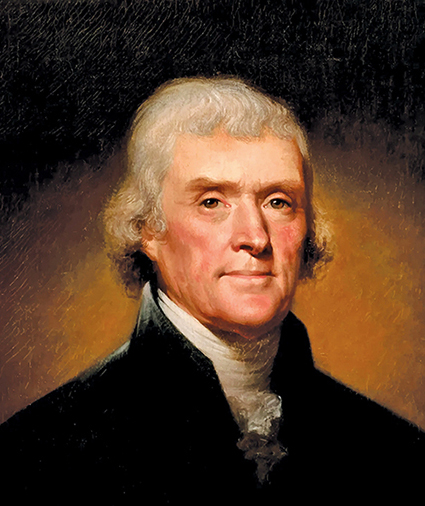
Thomas Jefferson
Brandon Dillard is slated to discuss the history of Monticello, the historical plantation of founding father Thomas Jefferson, as the Cashiers Historical Society continues its Mountain Heritage summer series.
“We’re excited to bring someone in who works at this landmark museum to kind of share some insight on how Monticello changes its story over the last 100 years,” said Amelia Golcheski, executive director of the Cashiers Historical Society. “It’s a really good exanimation to explain why narratives change about a place or about a person over a period of time.”
The upcoming discussion will be 3 p.m. Saturday, Aug. 2, at the Albert Carlton-Cashiers Community Library. Admission is free for CHS members and $5 suggested donations for non-members. Members should bring their membership cards.
“History is a process, and so we’re really looking forward to using this landmark institution as a case study, so people hopefully have a better idea or understanding of how we at CHS come to tell the stories we tell,” Golcheski said.
Dillard, who is an enrolled citizen of the Cherokee Nation, has an extensive career that focuses on the intersection of public, memory and race, with his upcoming discussion aiming to highlight the historical complexities of Jefferson’s legacy and how historical interpretation changes over time.
“The thing about Jefferson is that he is such a complex figure and there were so many lives at Monticello that it’s a conversation that could go in so many directions,” Dillard said. “We’ll talk about the contested nature of his political ideology and how that’s been drawn down on either side of partisan fights over the years.”
Dillard has a degree in philosophy from Georgia State University and cultural anthropology from University of Virginia. He is now a PhD student in American Studies at the University of North Carolina at Chapel Hill.
A key theme of the presentation will be the challenge of balancing Jefferson’s contributions to American democracy with his role in slavery. Dillard plans to engage the audience in this critical dialogue, encouraging them to consider the positive and negative aspects of his legacy.
“Monticello is a place that allows us to easily see the ideals of what it means to be an American at the home of the man who wrote our founding creed, the Declaration of Independence, juxtaposed with some of the harshest realities of our founding era and enslavement, and in the dispossession of our Native peoples,” Dillard said.
Monticello is not only an architectural icon, but also a UNESCO World Heritage Site, recognized for its historical significance. By fostering conversations about shared values and historical lessons, Dillard said he hopes to promote understanding and collaboration across different perspectives.
“I’m interested in encouraging people to think about things and to have conversations about hard topics, and I think that’s something we strive to do at Monticello as much as we can,” he said. “Especially right now when we’re living in this moment where it seems like it’s very hard for Americans to speak to one another across their political differences.”
- Kevin McCall
reporter@highlandsnews.com