
From the South Pacific to the Plateau, Wavra is committed to protecting the environment
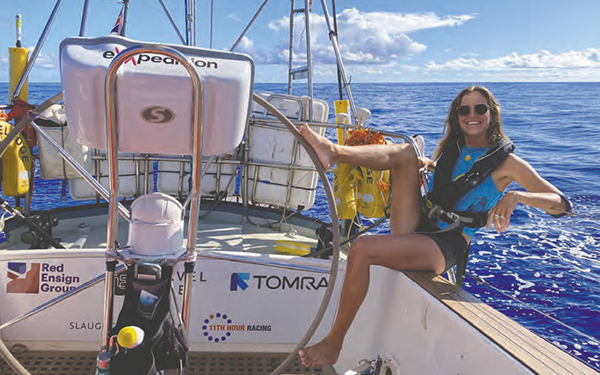
Whether she’s testing microplastics on Easter Island or working in the field with the Highlands-Cashiers Land Trust, Lynsi Wavra has built a career dedicated to preserving the places she calls home.
From the Florida Keys to Cashiers, Wavra’s various roles—as an organic gardner, instructor, captain, researcher and development
associate—have all contributed to environmental protection and preservation.
As a development associate with the HCLT, Wavra plays a key role in cultivating relationships within the community to preserve thousands of acres across the Plateau, stewarding dynamic ecosystems and species found nowhere else in the world.
“Since I so passionately believe in their mission, it has helped me operate in a positive way to affect change with the Land Trust,” said Wavra. “It doesn’t feel like a job. It feels really cool and I get to help people connect to this specific piece of land and hopefully protect it in perpetuity.”
A Cashiers native who moved to the Plateau at age two, Wavra developed a passion for the environment through time spent outdoors as a child. Her family founded Ty-Lyn Plantation, a christmas tree farm in Culowhee, where she became immersed in nature.
“I pretty much fell in love with the natural world and didn’t realize it was probably my best friend at that point in my life,” said Wavra. “That definitely shaped what I wanted to study, as I ended up going to University of Colorado Boulder for ecology and evolutionary biology.”
After college, Wavra followed in her mother’s footsteps into marine biology, taking an internship teaching children marine science in the Florida Keys. From there, she worked as a paddleboard tour guide and boat captain for Lazy Dog Adventures, leading tours through mangrove tunnels, and eventually purchased her own boat for excursions further offshore.
“I still got to satisfy that desire to share why I’m excited about the natural world with others and what they can do to help try to alleviate all the degradation that we see around us,” said Wavra. “But it wasn’t satisfying a deeper need to try to really connect people to what’s going on with the Earth and their role in determining the future of our species and all other species.” Wavra was able to do just that when she received the opportunity to partake on an all-women voyage from the Galapagos Islands to Easter Island to study microplastic pollution in 2020.
As part of eXXpedition’s 22-day journey through one of the most remote areas of the South Pacific Ocean, Wavra was one of 14 women tasked with testing for microplastics on the surface of the water and 30 to 60 feet below, while also capturing air samples.
Wavra said microplastics are often hidden but present everywhere, including in Arctic ice cores, making them a pervasive issue that must be addressed with the same urgency as their spread across the planet. In addition to conducting research for three hours each day, the group rotated responsibilities such as cooking, cleaning, and sailing, all while trying to find time to rest.
“It was a huge learning experience and adventure that I wouldn't trade for anything,” said Wavra. “It’s just one of those things that, when it's happening, it’s so difficult that you don’t see it that way until you touch land again and can look back and say ‘Wow, I did that.’”
She added that the program forced her to dig deep within herself and recognize her own strengths, and then apply those strengths to positively impact her community.
“We each have our superpower—something bigger than yourself that you can contribute to in your own unique way," said Wavra.
“If you focus on your strengths…I am a captain, so I’ll pass on this knowledge to everyone that comes on my boat, and I’m not
going to use single-use plastics and I’m going to talk about what happens when they make their way into waterways.”
With the rise in microplastics, Wavra said she hopes her message inspires people to adopt habits that allow them to coexist more harmoniously with the planet.
“By becoming more aware, you’re going to want to consume less in that lifestyle,” said Wavra. “It’s going to feel really empowering that you’re actually playing a more responsible stewardship role in your life and in your community.”
While on Easter Island, Wavra's interactions with local residents reinforced the importance of her work and her commitment to the
environment.
At the beginning of the COVID-19 pandemic, while the crew was unable to leave the boat, Rapa Nui residents paddled out in canoes, offering flower crowns and playing ukulele music. They expressed excitement about the expedition and a deep concern for the microplastics issue on the island—an experience that brought into focus for Wavra the impact and purpose of her work.
“Their island is disproportionately affected because a lot of these microplastics sit in the gyres, and within these gyres, there’s not a lot of current, " said Wavra. “The current moves around the outside of the gyre and is wind driven, so it's calmer in the center. Unfortunately, all the plastics sort of accumulate there.”
Wavra said she is thankful for the experience, and after a few more years of captaining, she returned to her hometown in 2025.
Thanks to connections from family and friends, she was put into contact with HCLT and soon joined the organization after relocating.
“This felt very aligned with what I was doing and when you care about the environment, your skills are going to transfer to any sort of organization in that field,” said Wavra. “Those observations I made from being a captain can now be put towards seeing what areas of our Plateau up here are most vulnerable and which species are at risk of extinction.”
Whether she’s building relationships with donors to save valuable pieces of land on the Plateau or hiking local trails with her
dog, Wavra has come full circle in her career with her return. Surrounded by family and friends, along with colleagues who share
her passion for conservation, she hopes to continue inspiring others to get involved, believing meaningful change begins with small, everyday choices.
“It’s always about the small choices that you make throughout the day and starting with changing one aspect of your life, and if you change one thing each day, that accumulates,” said Wavra. “You can connect with someone through a story, vulnerability or through showing something you struggled with. Just by meeting someone from that point can really lead to positive change.”
- MITCH STONE
REPORTER@HIGHLANDSNEWS.COM