
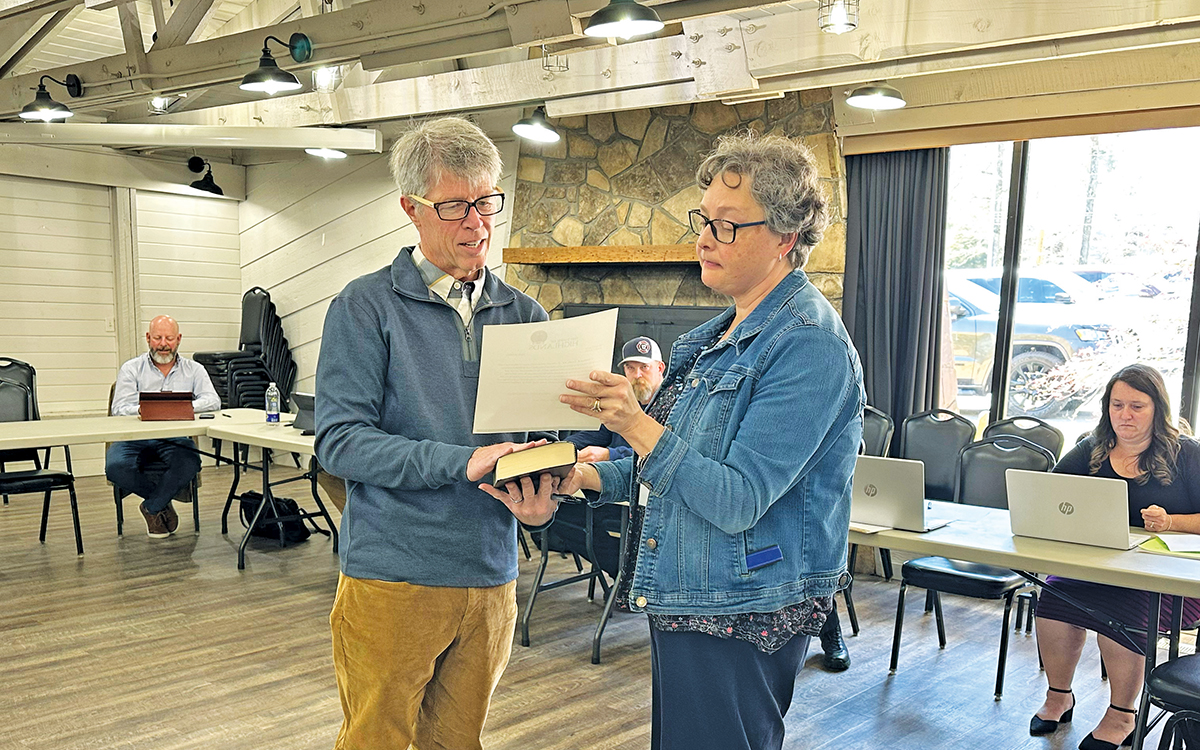
The Town of Highlands Board of Commissioners approved a fire tax increase and reached a consensus on several requests and proposals during its first budget workshop of the month on April 9. Newly elected Commissioner Bill Grubb was also sworn in at the start, allowing him to immediately participate in budget discussions.
Fire Department Budget Approval
Chief Ryan Gearhart proposed a 2.5-cent increase to the Highlands Fire District fire tax, from .0191 to .0441, and outlined budget requests for the 2026-2027 financial year.
One of the most substantial increases was in salaries and wages, which increased from $317,031.01 as of March 6, 2026, to a proposed $642,000, due to the potential addition of three new firefighters. Part-time salary requests also increased, from $13,322.97 to $63,000.
Capital outlay and equipment requests also saw a notable increase, increasing from $31,657.45 to $309,151. The budget requests totaled $2,465,651.
Because Macon County commissioners required a decision on the fire tax increase, the board unanimously approved it, though at a reduced rate.
“We were able to reduce it and the increase takes us from 1.91 cents to 3.91 cents, which will make Highlands still have the lowest fire tax rate in the county,” said Commissioner Jeff Weller.
The town now awaits the county’s decision.
Town Manager Josh Ward said he also spoke with Jackson County Manager Kevin King to request a review of the current fire tax values.
“They had a rebound last year in Jackson County and we’re unaware of the value for all the properties within the town of Highlands that were in Jackson County,” said Ward. “So, he didn’t have an issue with working with finance to charge these folks the same as our fire tax in Macon County.”
Ward will communicate the proposed fire tax increase to the Jackson County manager and await a decision.
Capital Requests
Ward introduced the 2026-2027 capital requests, noting that several items have been amended since similar numbers were presented at last month’s board retreat.
Ward said the street department’s asphalt tamp required replacement, totaling $7,000 and was already purchased through an emergency budget amendment.
Following discussions about truck replacement at the retreat, Ward added that Finance Director Rebecca Shuler used state contracts to reduce proposed vehicle prices. The cost for a 2017 Toyota Tundra was cut from $65,000 to $55,000, while the cost of an Administration Nissan pickup truck was dropped to $45,000.
An additional $60,000 was added to the budget for a Town Hall property study.
2026-2027 capital requests totaled $23,820,995, with $1,421,800 from general fund departments, $3,278,500 from the electric fund and $19,120,695 from the water and sewer fund.
The town also remains undecided on the Hudson Library’s renovation cost request of $350,000 and the replacement of trees along Main and Fourth Streets, along with the legal review of the town’s unified development ordinance as they await a decision on Session Law 2024-57 Senate Bill 382.
“They did start working and have worked through the sign ordinance, but it has stalled because our attorney said there’s no use in moving forward until we know what we can and can’t do,” said Ward. “So we’re kind of waiting on the state legislature to adopt the correction or budget.”
Land use fee increase proposal
Planning and Development Director Michael Mathis noted that the town spent over $20,000 on legal fees for services provided to the Zoning Board during the 2025 financial year. With the current application fee for special use permits, variances and administrative appeal hearings set at $250, the staff recommended increasing the amount to $1,000. “After doing some research, I noticed other places in North Carolina are charging higher application fees for Zoning Board hearings,” said Mathis.
Mathis also proposed adjusting the fee for a conventional rezoning to $1,000.
“Rezoning fees in the City of Asheville range from $1,000 to $2,500, depending on the size of the property,” said Mathis.
“Furthermore, the application fee for conditional rezonings in the Town of Highlands is $1,500.”
The final proposed change was to charge $100 for zoning confirmation and determination letters, which are typically requested by the closing attorney when a property sells.
“The reason I brought up some of these is because first off, it’s going to help you recoup some of the legal fees we’ve been spending,” said Mathis. vMathis added that the price increase could discourage “nonsense” variance requests that are unlikely to be approved.
The board reached a consensus in favor of the proposed changes.
Water and sewer rate review
Finance Director Rebecca Shuler outlined three options for raising water and sewer rates, citing project costs and lack of previous increases that led the town to take an interfund loan from the electric fund. With additional projects expected in the coming years, staff recommended a substantial rate increase, before transitioning to an annual increase of 4% to cover inflation.
“Part of the reason for the increases is, we were told, when we go for grants, we weren’t getting them because our rates are too low,” said Weller. “The state wants grants raised to be competitive in the market and other municipalities.”
The board reached a consensus in favor of a 10% increase for water and sewer rates, with the additional 4% increase planned for future years. The initial 10% increase will generate $138,320.16 from residential and $22,830.72 from commercial.
Cost-of-living adjustment
The board expressed support for a 3% cost-of-living adjustment to help offset inflation. The increase would cost $147,364, compared to $103,245 for a 2% adjustment.
- Mitch Stone
reporter@highlandsnews.com