
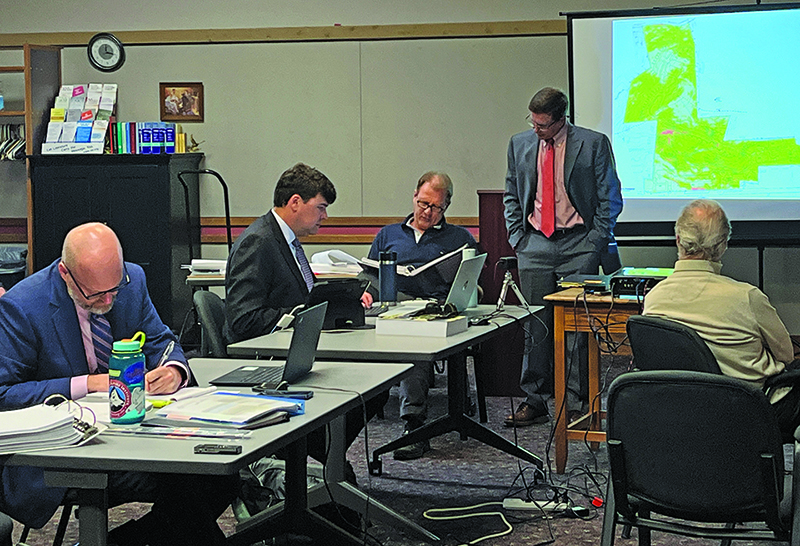
The ongoing Cashiers Marketplace hearing resumed on April 9. While they already scheduled their next four meetings, for May 6 and May 20 at 1 p.m. and May 7 and May 21 at 9 a.m., the proverbial light at the tunnel seems closer. During the most recent hearings, Marketplace attorney Brian Gulden called six field experts and Marketplace developer Fritz Rybert forward. Gulden indicated having just one more expert, a traffic expert, and opposing counsel will need time to call their witnesses, about eight, and there is a community section before the hearings conclude.
The April hearings included similar discussion on property slopes, buildability, water infrastructure and treatment, silhouettes, and development requirements. New discussion included in depth hydrology and property appraisals. Marketplace’s experts attempted to solidify the fact that Marketplace achieves all requirements, is equipped to handle the project, and will minimize negative impacts that stem from every development.
Gulden first called Marty Kocot, registered professional engineer and owner of LandWorks Engineering PLLC, to the witness stand. Kocot’s testimony essentially recapped his March testimony.
Kocot said schematics generally follow the most buildable areas on the property, stormwater is intended to capture the required 85 percent of total suspended solids close to the source, water will be provided from offsite wells in Sapphire Valley, and the development meets requirements.
There will be a large amount of site grading to level the field. The steepest contour will require an 18 percent grade. Underground grading will also be required for the parking tunnel. Kocot speculated the total disturbed area on the property is over 70 percent, although Marketplace experts reiterated that they will try to minimize vegetative impacts, including keeping as many trees on the property as possible.
Per Jackson County ordinances, proposed structures shall not be sited atop peaks where they will be visible by public right of ways. Kocot believes the property shouldn’t be visible because it is 85 feet lower than the monopole in Cashiers. In later cross examination of Lamar Wakefield, CEO of Wakefield Beasley Associates, T.C. Morphis, representing those with standing, questioned if the hotel would be visible simply because it is a different structure than a thin cellular pole. Any visibility is expected to be minimal with attempts to preserve vegetation.
“With the trees and those elements, we’ve demonstrated it is difficult to see the hotel peak,” Kocot said. “Certainly, we’re concerned about how things look around the hotel.”
Kocot said water usage and storm and wastewater disposal will be managed.
“Our expectations are to capture runoff at the source and add redundant measures to collect and treat stormwater as it runs down the hills,” Kocot said. “We intend to include stormwater plans that make sense in their placement.”
Water will be sourced from four wells in Sapphire Valley and serviced through Carolina Water Service. A sewage pump station will be located on the property and Kocot said there are plans to include odor control measures and limit flow to what it was prior to development.
Gulden called a water resources expert, Buddy Melton, forward. Melton said he looked at Marketplace’s needs, the pump capacity, and the site, along with state and county requirements, to make a compliant water system.
The Cashiers area water system presents its own challenges. All parties draw from underground water reserves, but there is no overall utility that allows users to proactively work together.
“The best we can do is manage these resources appropriately,” Melton said.
Melton said Carolina Water Service must own and control the wells, but they are sourcing them to the Marketplace development. Melton also said the four wells should provide sufficient capacity for Marketplace at nearly double their requirements. Additional
CWS will need to acquire additional wells to connect water from near Ingles to the development site. Interconnection of lines will be required, but the exact extent is not known. The recharge of other wells that may be impacted are not yet determined.
Gulden called Clement Riddle who performed an environmental assessment. Riddle said the assessment found no potential for endangered species or potentially jurisdictional waters of the United States, however, no official site survey was conducted for endangered species.
Heading into the second day, Gulden first called Lamar Wakefield, architect and CEO of Wakefield Beasley & Associates. Wakefield said he is more than familiar with the Cashiers characteristics and wants and needs. He also said he frequently designs projects on steep slopes and incorporates them into the landscape to minimize grading.
Wakefield said the average street grading will be around 12 percent and vegetation impacts are intended to be minimal. The development intends to preserve 45 percent of the green space while also offering around 7,500 feet of sidewalks and trails.
“It would be a shame to take down that green screen. We’re not going to do that,” Wakefield said.
Housing is another issue on the property. There are 21 proposed residential cottages and 30 proposed affordable housing units. Marketplace plans to use that housing for its workers, but they indicated excess properties may be available for the community, but that is not guaranteed.
“We should build more things workers can use, rather than building more things that require workers,” Judy Zachary, a member of the planning council who was recused due to standing, said
Planning council member Douglass Homolka questioned the controls to prevent backsliding into a spring-fed well system. Wakefield said retaining walls, if any, are expected to be minimal.
Gulden then called Gerald Green, former Jackson County planning director with extensive experience in Cashiers, including co-writing the small area plan.
Green said the density, scale, bulk, and overall dimension are appropriate for Cashiers and that if approved, Marketplace would help address walkability in Cashiers and provide additional support for first responders in the form of roadways and excess water storage. Green said this will add to the civic nature of the Cashiers village.
Green said with the waste and stormwater regulations in place, he doesn’t think the project will impact flooding on Frank Allen Road.
Gulden also called Matthew Kyle Winters, a real estate appraiser in North Carolina and Virginia. Winters provided data on potential positive impacts of retail development on residential properties in areas like Raleigh and Asheville based on overall sales price and price per square foot.
“Retail is often clustered together. It’s cohesive and it can encourage foot traffic to other retail,” Winters said. “Anytime you have warm bodies in houses, they go out shopping, which boosts retail.”
Winters pointed to larger-scale developments that had no negative impact on neighboring properties. Morphis said it wasn’t proper to compare Cashiers’ developments with Raleigh or Asheville, and John Noor, attorney for Kessler’s neighboring East Village property, said impacts on their property weren’t considered and nor was there a demand analysis or feasibility study. The Village Green attorney Rob McNeal had similar concerns on the impact of The Village Green.
Finally, Gulden called Rybert, who said the housing units can house community members if they aren’t being used by hotel staff. There are 44 planned affordable housing units, but employees are likely to exceed 75. Rybert also mentioned plans to build accordingly, starting with the hotel. The commercial element is expected to develop later.
“It’ll be built in small increments according to that particular demand,” Rybert said.