
Some may dismiss bugs as an annoying pest to kill, but for guests attending this year’s Neighbors for Conservation event at Camp Merrie-Woode, bugs can now be seen through a new lens as an important part of Earth’s ecosystems.
“Humans can’t survive in a world without insects because they’re so incredibly important for pollination and food sources and all these things. And so, the talk is, how do we create beautiful landscapes brimming with life, landscapes that support pollinators, herbivores, predators, etc.,” said Robin Walker, executive director of Camp Merrie-Woode.
The Neighbors for Conservation event is held each year for the purpose of focusing on sustainability initiatives that will benefit the Cashiers community, bringing in an expert to serve as a key speaker.
“I would say the mission is to bring together members of the community to talk about conservation matters and things that we can do on our property that will have an impact in preserving the beautiful landscape that we all appreciate so much,” she said.
This year’s event invited entomologist Doug Tallamy, a nationally recognized expert, to speak on insect wildlife and their impact on the environment. He spearheads Homegrown National Park, which according to Walker, is a project that aims to support conservation efforts by cultivating the necessary ecosystems for yards.
“If we can get a lot of people to do that, that will create a similar impact to having conserved land like a national park, because even though they’re all small individual lots, you can have a huge impact on the ecosystem because it’s hard to protect those big tracts of land,” she said.
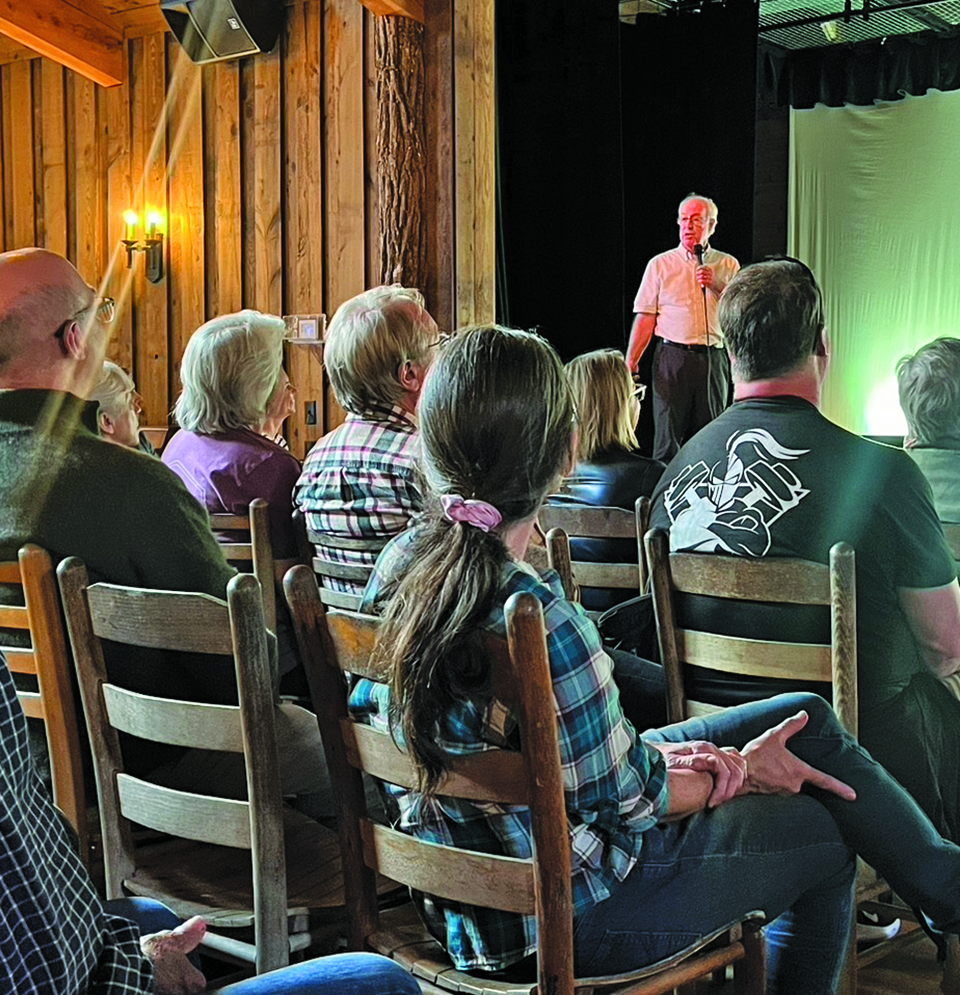
Tallamy greeted guests at Camp Merrie-Woode last week and gave a presentation about the importance of preserving for this year’s Neighbors for Conservation event, co-sponsored by the camp alongside Highlands-Cashiers Land of Trust, the North Carolina Native Plant Society, The Village Green and the Land of the Sky Chapter of Greater Asheville. The main focus for this year’s event is for locals to begin utilizing this same mission for their own property.
“Insect-functioning ecosystems are not optional. They’re essential. They’re essential for everybody,” Tallamy said. “Let’s say our pollinators disappeared. That means 90% of our flowering plants would disappear. And if that happens, the food webs that support our vertebrate animals would all collapse. So, you’d lose our amphibians, our birds, our reptiles, and our mammals, which includes us.”
According to Tallamy, around 80% of plant life in the yards of locals are from non-native plants, which are not able to support the insect population needed for a sustainable ecosystem. As a result, their decline begins impact the ecosystem around them.
“People like birds, but they think all birds need is the seed in their feeders. But 96% of the birds that people like rear their young on insects. So, you take the insects away, you lose the breeding birds. A nest of chickadees requires 6-to-9,000 caterpillars just to get the babies to leave the nest. That’s one nest of a bird. That’s a third of an ounce,” Tallamy said.
Tallamy further illustrated this point by highlighting the bee population, which has seen a significant decline over the years, with four species alone seeing a 96% decrease from the past two decades. He added that three species may already be extinct, with 25% of all bumblebee species facing the threat of extinction.
However, Tallamy showcased the options for locals interested in taking initiative to combat the crisis. For those interested in creating a sustainable landscape for local insect populations in their yard, he offered several points to follow that can help spearhead the overall mission of conservation, starting with the removal of invasive plant species.
“Plants from other continents are very poor at supporting our insects. So, you want to choose native plants. You want to choose the best native plants because they’re not all equal,” Tallamy said.
Tallamy mentioned specific plants that locals can include into their yards, such as goldenrod, asters and sunflowers, which he said are the three most important herbaceous plants that support insects like caterpillars.
“Then those woody plants, the oaks, are the most important. But you know, the trees you see growing around you are. They’re all leaders in supporting insect populations. But some ginkgos from China? Nothing,” he said.
Additional points to follow include, using keystone plants, landscaping for caterpillars, reducing light pollution, minimizing insecticide use, such as mosquito spray, sharing a native plant, planting for specialized bees and cutting your lawn in half.
“You know, we’ve got 44 million acres in lawn,” he said. “Lawn doesn’t support pollinators, it doesn’t support a food web, it doesn’t sequester carbon, it doesn’t manage the watershed. So, reducing lawn becomes really important.”
Lastly, he encouraged everyone to join their HOA with the goal of implementing change within for a better future.
“I want to talk about personal responsibility. You know, we say we have this private property, we’re owning a piece of the earth,” he said. But if you’re owning a piece of the Earth, you’re also owning the responsibility of taking care of that piece. We need nature. We need functioning ecosystems everywhere, not just in parks and preserves.”