
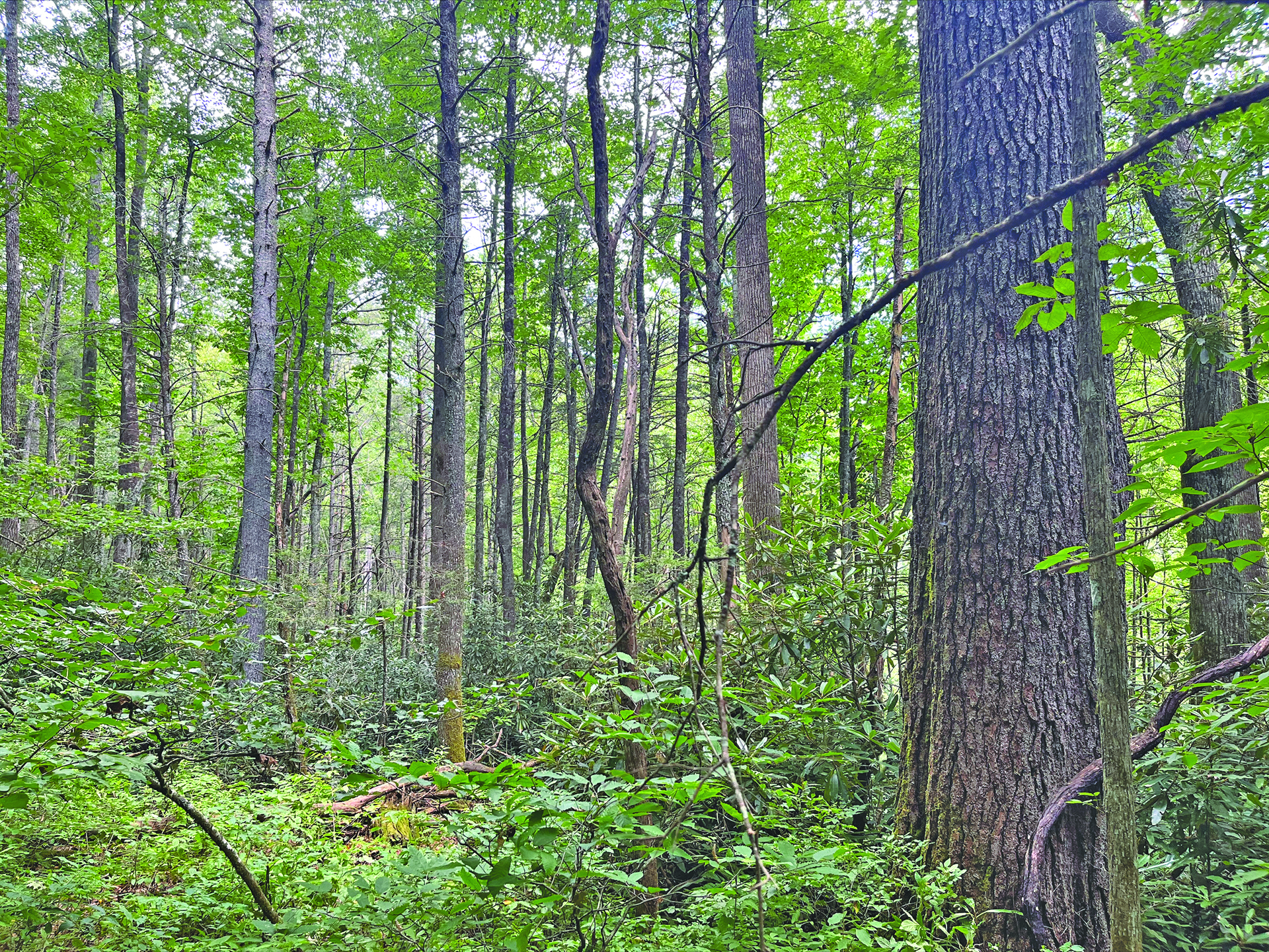
A coalition of five conservation groups has filed a lawsuit against the U.S. Forest Service over the Southside Timber Project, which involves logging in the Nantahala National Forest.
The lawsuit challenges the project by the U.S. Forest Service to commercially log within a Forest Service-designated “exceptional ecological community” of the forest.
The suit was filed on Jan. 31 in the U.S. District Court for the Western District of North Carolina by the Southern Environmental Law Center on behalf of the Chattooga Conservancy, the Center for Biological Diversity, the Defenders of Wildlife, MountainTrue, and the Sierra Club.
The defendants in the suit are the U.S. Forest Service and Troy Waskey in his official capacity as district ranger for the Nantahala District of the Nantahala National Forest.
Waskey could not be reached for comment.
The 24-page lawsuit argues that the Southside Project violates the National Forest Management Act because it is inconsistent with the 2023 Forest Plan’s requirements for special interest areas. The suit also claims the project violates the national act because is inconsistent with the plan’s requirements for scenic-eligible rivers.
The area subject to the suit is a 15-acre stand known as Stand 41-53 that is described as “small but of remarkable ecological importance and that the state, through its Natural Heritage Program, has designated the area as an ‘exceptional’ Natural Heritage Natural Area due to the presence of rare species and exemplary ecological communities.”
Natural Heritage Natural Areas are areas of “special biodiversity significance” and “exceptional” is the highest ranking given by the state.
The stand is adjacent to the Whitewater River, a trout stream that has unique features that are not found anywhere else in the eastern half of the U.S. or the southern Appalachian Mountains, the suit said. The Whitewater River is located between Hwy. 107 South and NC-281 and flows across the North Carolina-South Carolina border.
The USFS administratively tracks the conditions of portions of the national forests using numbered “stands,” which are relatively small areas typically managed as a single unit. Contiguous groups of “stands” comprise larger administrative units called “compartments,” according to the lawsuit.
The plaintiffs are asking for a declaratory judgment by the U.S. District Court that the logging authorized by the Southside Project in a 15-acre stand of the Nantahala National Forest violates the national act and that the USFS must update its ongoing projects to be consistent with the 2023 Forest Plan.
“The imminent logging is inconsistent with the Nantahala National Forest’s governing management plan and therefore violates the National Forest Management Act,” the suit alleges.
The Nantahala National Forest, including the Southside Project area, is governed by the plan.
The Southside Project was initially proposed by the U.S. Forest Service in 2017 and calls for commercial logging on about 300 acres dispersed throughout an analysis area of more 29,090 acres in southeastern Macon County and southern Jackson County just east of Highlands. An objection process carried into 2018 and a final decision was made to move forward in 2019.
The purpose of the Southside Project is to thin old growth areas to spur new growth. New growth will make the forest more resilient and sustainable by improving breeding and foraging habitat for wildlife by incorporating young trees in the 0–10-year age class that makes up about 1 percent of the project area.
Young forest habitat provides food and cover for a diversity of wildlife including bats, ruffed grouse, and pollinators, the USFS said. Many species of wildlife need young forest to complete their life cycles, including some that also depend on older forest habitat.
A diversity of tree ages also helps maintain healthy forests that are more resilient in the face of forest pests and changing climates.
The U.S. Forest Service first proposed the Southside Timber Sale in 2017. When plans were eventually finalized and the proposal moved forward for bidding in 2021, no bids were received.
According to the U.S. Forest Service, the sale area is in the Nantahala National Forest, Nantahala Ranger District, approximately eight miles south of Cashiers. It includes 469 acres, 98 of which are designated for cutting.
In 2018, the Chattooga Conservancy, the Defenders of Wildlife, The Wilderness Society, MountainTrue and the Southern Environmental Law Center, along with many private residents, issued formal opposition to the project during an objection process.
The objections to the proposed harvest stemmed mainly from two issues the conservation organizations perceived with the plan: the existence rare old growth trees in the targeted areas, and a habitat for a species of salamanders that had seen a dramatic decline in population.
In February 2021, The Crossroads Chronicle reported that the project would also target some of the forested areas in and around Cashiers, including plots on Brushy Mountain, areas adjacent to Granite City and along the Round Mountain Spur of the Foothills Trail.
Brushy Mountain is located south of Cashiers on land between two steep watersheds, the Chattooga Wild and Scenic River and the Whitewater River.
Five years after the Southside Project was proposed, the U.S. Forest Service awarded in 2022 a timber bid to cut the first 98 acres of 317 acres to be harvested.
“The Southside timber sale shows that the Forest Service leaders are more interested in logging than protecting rare and beloved landscapes,” said Will Harlan, southeast director at the Center for Biological Diversity, in a press release that was issued about the Jan. 31 lawsuit. “The public strongly opposes logging this ecologically unique forest beside a trout stream and waterfall, but the Forest Service wants to cut it down anyway. This is a clear and heartbreaking example of the conflicts we can expect to see under the new forest plan.”
The suit said the Forest Service’s logging plans for this area have been contested on two fronts through development of the Southside Project itself and, simultaneously, through the separate process of revising the Nantahala-Pisgah Forest Plan.
The National Forest Management Act requires each national forest to be governed by a forest-specific Land and Resource Management Plan, often called a “forest plan.” Among other things, forest plans decided what activities, such as logging, recreation, and mining, may occur in which parts of a national forest, why they can occur, and under what conditions.
Pursuant to that act, all Forest Service actions, including logging projects, must be consistent with the governing forest plan.
“The Southside Project is a case study of the Forest Service’s reckless resolve to push harmful logging onto exceptional landscapes,” said Nicole Hayler, executive director of the Chattooga Conservancy. “Logging in this area along the Whitewater River is a prime example of the root of the problem: deeply flawed, perverse incentives driving the Forest Service to hit mandated timber targets, which is why the entire Southside Project should be dropped.”
The Chattooga Conservancy has objected to the project from the beginning and specifically asked that areas of old-growth forest be taken out of the project if it does move forward. The conservancy contended that the project would also eliminate habitat areas for the rare green salamander and have a negative impact on native trout habitats.
The environmental organizations said the Forest Service developed the Southside Project under its 1987 Forest Plan for the Nantahala-Pisgah National Forests while that plan was being revised. It is to be implemented under the Forest Service’s new 2023 Forest Plan.
“When project development and implementation occur alongside forest plan revision, the National Forest Management Act requires the Forest Service to review projects that bridge the divide between the old and new forest plans for consistency with the new plan,” the suit said. “Projects that are inconsistent with the new plan must be abandoned or modified to ensure consistency with that plan.”
The environmental organizations behind the suit say the Southside Project can only move forward if it is consistent with the Nantahala-Pisgah National Forests’ 2023 Forest Plan.
“The Forest Service has planned to conduct heavy commercial logging within the contested area since it proposed the Southside Project in 2017, prior to final revision of the Forest Plan,” the suit said. “Despite the ecological importance of the area and repeated requests from plaintiffs during development of the Southside Project, the Forest Service never abandoned its plans to log this area. The logging risks destroying many, if not all, of the area’s special ecological values identified by plaintiffs, the state of North Carolina, and the Forest Service itself.”
The organizations opposed the Forest Service’s plans and said they and the state have “repeatedly” asked the national service to preserve the area’s values by placing it in a protective area as part of the forest plan revision process. They allege the USFS has refused the requests as part of its efforts to increase the proportion of the Nantahala-Pisgah National Forests where commercial logging is minimally restricted.
The suit alleges the 2023 Forest Plan calls for a quintupling of logging on a significantly larger acreage footprint than the plan from the late 1980s, including in old-growth forests, rare and exemplary wildlife habitats, and remote areas without roads.
“This year’s plan, which will govern projects like the Southside Project for decades, is in most respects inadequately protective of the Nantahala-Pisgah Forests’ ecological values,” the suit said. “For that and other reasons, approximately 14,000 people filed formal administrative objections to the Forest Plan. But in one of the new Forest Plan’s few bright spots, the Forest Service, in response to the consistent advocacy of the plaintiffs, the public, and the state, eventually completed biological surveys of the area contested in this lawsuit, formally recognized its exceptional ecological values, and placed it into the ‘special interest’ management area.”