
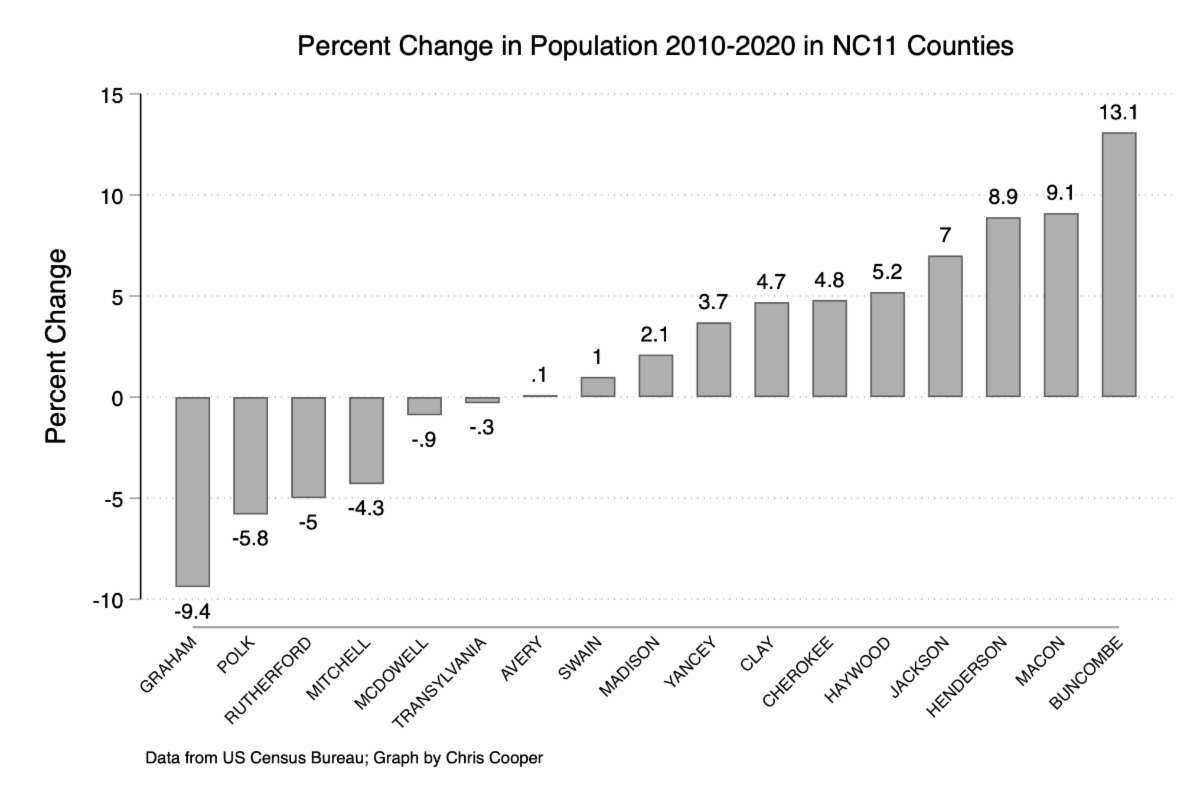
Macon and Jackson County both saw an uptick in population on the 2020 Census, but the town of Highlands has stayed about the same.
The population of Highlands increased by about 60 people, from 920 to 984 in this years’ census.
“Several people would have thought that we would have seen a boom on the census this year,” Highlands mayor Patrick Taylor said. “Clearly that is not the case. The year-round residential population basically has stayed the same in the last 10 years.”
The census does not track seasonal residents, which does cause an increase in the Highlands population in the summer months.
“That has always been the case with our seasonal residents,” Taylor said. “But the people that actually live here full time and vote has always been a very small population.”
Taylor said there are several things happening in the coming years that will hopefully incite people to move to the area.
“Especially with the addition of our broadband network, I see a lot of people coming to the area,” Taylor said. “This is sort of how the short-term rental situation comes into play. My concern is the civic life of Highlands. If we continue to convert to these short-term rentals, we lose the permanent people that contribute to the quality of life here. It’s not just economic development for me.”
Jackson County grew seven percent in the last 10 years and is still a predominantly white county, with the number of residents over the age of 18 barely moving within the past decade.
Data released on Aug. 12 by the U.S. Census Bureau showed that Jackson County grew in population by about 2,800 individuals since 2010, ranking it as the 61st largest county in North Carolina.
The data shows a county that has grown seven percent since 2010, jumping to 43,109 people. Over that same period, North Carolina’s child population grew by 2,654, an increase of 0.1 percent. The adult population grew by 901,251, an increase of 12.4 percent, according to census data.
“The big highlight to me is that there’s not a lot of growth,” Western Carolina University political science professor Dr. Chris Cooper said. “There was not a single block in Jackson County that lost population. That’s kind of unusual for the state because the big headline is, and it’s correct, that rural areas are losing people and urban areas are gaining. That’s not true in Jackson.”
Jackson County had about the fourth largest growth in Western North Carolina, following Buncombe at 13.1 percent, Macon at 9.1 percent, and Henderson at 8.9 percent. Haywood ranked fifth at 5.2 percent growth, Cooper said.
Nevertheless, Cooper said the Cashiers area of Jackson County as well as Macon County saw some of the most dramatic growth in the western part of North Carolina. Macon County’s population grew to 37,014 compared to 33,922 in 2010.
“The amenity rich areas of the state seem to see the most growth, so we saw some of that on the coast, in the mountains and in some of the rural areas,” Cooper said. “That’s folks coming in from South Carolina, of course from Atlanta, and it’s more Highlands growth than the Cashiers specific growth.”
Nationwide, more than three-quarters (77.9 percent) of the population is age 18 and over. Macon County followed that trend with 82 percent (30,345) of the population age 18 and over. As of April 1, 2020, Macon County had 26,948 housing units with 60 percent (16,379) occupied. According to the census, 318 people (.9 percent) lived in group quarters, which includes 229 people in institutional settings and 89 in non-institutional quarters.
According to the Census Bureau, 86 percent of the country’s residents live in metro statistical areas, compared to 85 percent in 2010. The nation grew at its slowest rate since the 1930s and less than half of the nation’s counties gained population.
In Jackson County, the number of children grew by 2.8 percent from 2010 to 2020. Those who are 18 years of age and older in Jackson County totaled 83 percent, an increase of about 11 percent since the 2010 census.
“We don’t have all the specifics yet until the next data release, but I think it does give us a good idea at least that the growth is among the voting age population for the most part,” Cooper said.
White residents made up about three-quarters of Jackson County’s population, with 7.6 percent of the county also being Hispanic and 1.7 percent of the population being African American.
There are 10 census tracts in Jackson County, and Cashiers is part of the southernmost tract of the county. This census tract is about 88 percent white, according to data from the U.S. Census Bureau.
Cooper said the 11th North Carolina Congressional district, which includes Jackson and Macon counties, was the whitest district in the state both before and after the 2020 census.
“Yes, clearly, we are not a particularly racially diverse county or region,” Cooper said. “That doesn’t mean there are pockets that shouldn’t be represented.”
The data is from the 2020 Census, a once-per-decade head count of the country’s population, which was released on Aug. 12 by the federal government. Mandated in the U.S. constitution, the primary purpose of the census is to apportion congressional districts. States also use this data to draw legislative districts.
Because the statewide population of North Carolina grew by about 9.5 percent between 2010-2020, the state will get a 14th seat in the 435-member U.S. House for the 2022 election cycle, and a 16th Electoral College member based on this data.
Over this same period, 51 North Carolina counties lost population, while 49 others gained population, including Macon and Jackson.
North Carolina lawmakers will convene later this month during a special session to hammer out those lines. The process will be fraught with political drama as Republicans and Democrats wrangle over which parties will control those districts, possibly for the next decade.
Cooper said the response rate in the western part of the state was particularly lower than in the rest of the state mainly because of a “distrust in the government.”
The final self-response rate for those answering census questionnaires in Jackson County was 36.7 percent, according to the North Carolina census website. That means that about 65 percent of the county was undercounted.
About four out of every 10 Macon County residents responded to the survey, while 52.2 percent of Transylvania County’s residents filled out the questionnaire.
But over the past 30 years, the self-response rate in Jackson County has declined during the three once-in-a-decade surveys in 1990, 2000 and 2010. In 1990, more than half the county responded, but that dropped to 48 percent in 2000 and even further to 33 percent, according to data from the NC Counts Coalition.
“Part of it I think is this distrust in the government that you see not only across the state but in the western part of the state particularly,” Cooper said. “Whenever we do polling in Western North Carolina, we usually find that the trust in government is lower here than it is in other parts of the state.”
Cooper said this will affect how much funding some of the federal programs in Jackson County and Western North Carolina will get – especially if more than half of the county’s population was potentially undercounted.
In the 230-year history of the census, its purpose has expanded greatly. Not only does it provide in-depth demographic data for county populations, but it will also determine how much federal cash flows to local governments, an amount tied directly to where people live.
Census data determines the distribution of about $1.5 trillion of federal funding across state and local governments. In fiscal year 2016, nearly $24 billion in federal funds were allocated to North Carolina through 55 programs guided by the 2010 census, according to ncdemography.com.
That money could be used for programs such as the Head Start program, Supplemental Nutrition for Women, Infants and Children, the Child Care Development Fund, the Early Intervention Program for Infants and Toddlers with Disabilities, the Special Education, Preschool Grants, and a host of other initiatives.
“They [the Census Bureau] has to sort of guess how much funding these programs should get based on the data they do have,” Cooper said. “That’s not what anybody wants.”
Christopher Smith, Michael O’Hearn and Mia Overton contributed to this article.