
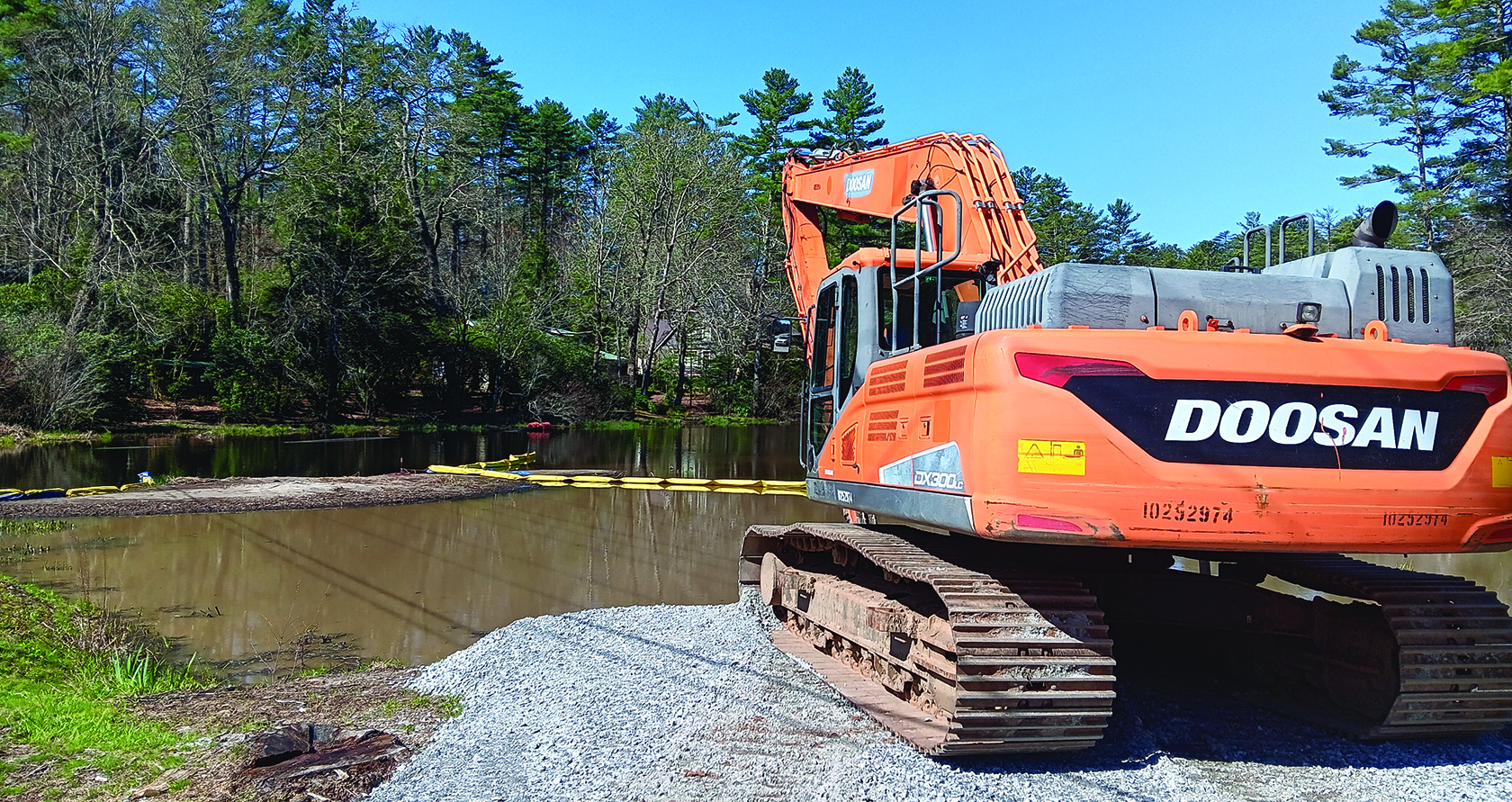
The dredging of Mirror Lake is going to happen. In fact, the process is already underway.
But the scope of work, the length of the project, and the cost are still to be determined.
On Tuesday night the Highlands Board of Commissioners held a specially called board meeting with engineers from McGill and Associates to discuss the scope of the dredging effort.
“We have been discussing dredging Mirror Lake for years, mayors before me, myself, this board, and now we are finally starting to get the ball rolling on that project,” Mayor Pat Taylor said. “As everyone here knows, we received $5 million in grant funds from the state for the dredging. What we are here tonight to do is go over the options for the scope of work and give the engineers some guidance as to how we want to proceed.”
Taylor noted that “phase one” of the project is already underway with some hydraulic dredging being done in the main channel of the lake. The next phase will be determined by town directive.
Mike Hampton, McGill and Associates’ expert on water-related projects, presented findings from a survey and environmental assessment the firm completed in March.
“Mirror Lake is interesting because there are places where the depth is only a few inches, and there are places in the middle of the main open water area that are roughly 18-19 feet deep,” Hampton said. “The areas most impacted by sedimentation have been the area where Mill Creek enters the lake, which has created an actual wetland, and the area near the Mirror Lake Road bridge.”
Hampton noted that the survey found a depth of sediment anywhere from 1-4 feet in the riverine (upstream) portion of the lake and anywhere from 2-10 feet in the main open water area.
Hampton then presented three options for the scope of the dredging project.
Option one, called the “maximum depth option,” would essentially restore the lake area to what it looked like when it was originally created roughly 80 years ago. In order to dredge the entirety of the lake, to its original depth, Hampton estimated 113,000 cubic yards of sedi-ment would need to be removed.
The estimated cost for option one is roughly $6.1 million, which of course, is more than the $5 million the town has budgeted for the project.
“With option one we are talking about a massive amount of sedimentation to be re-moved, and that comes with costs, because not only do you have to do the dredging work, but you have to dispose of the sediment,” Hampton said. “It has to be loaded into trucks, and taken offsite to an approved disposal site or permitted landfill that will accept it.”
Option one would also require a combination of hydraulic dredging and mechanical dredging, which may make the process of getting permits from stakeholding agencies more difficult and time consuming.
Hydraulic dredging is a process by which sediment is pumped out of the lake, run into pervious bags, allowed to settle and de-water, then loaded in trucks and removed. Mechanical dredging requires heavy equipment having access to the waterway and/or adjacent wetlands.
Hampton presented option two, called the “wetland preservation option,” which would essentially have as little impact on wetland areas as possible and focus on problem areas in the main channel, like the area near the bridge.
Option two would require the removal of roughly 90,000 cubic yards of sediment and come with a cost of approximately $4.6 million which is within the town’s budget.
Hampton then moved on to option 2A, called the “hybrid plan to optimize recreation.”
“Option 2A would essentially remove the same amount of sediment as option two, but do that in a different area,” Hampton said. “We would leave the deepest part of the lake as it is a the current depth, and dredge a five-foot wide channel through the Mill Creek wetland area to open that back up for recreational purposes like canoeing and kayaking. That was one of the items in previous meetings that the Mirror Lake Association indicated was important and it can be done.”
Option 2A would come with a cost of roughly $4.5 million. Hampton gave a recommendation to the board of proceeding with option 2A via a three-phase process that would take roughly 18 months to complete.
He added that the town should build a Mirror Lake maintenance plan into its future budgets to make sure that large scale sedimentation is addressed annually rather than every 70-80 years.
“It’s easier to eat an elephant in small bites rather than trying to do it like we are now in one big gulp,” Hampton said. “Putting in sedimentation catch basins, runoff collection areas, etc. would go a long way to ensuring this problem didn’t occur again. The last thing anyone wants to do is a multi-million dollar dredging project and then have to come back and do it again in 20 years, 30 years, or whatever the timespan may be.”
Pat Gleeson with the Mirror Lake Association asked if fundraising was done to bring in additional money for the project if the scope could be expanded while it was ongoing.
“Mayor Taylor has indicated that due to Hurricane Helene recovery and other projects around the state, that there will be no going back to the state for additional funds, but what about if we raised the money ourselves,” Gleeson said. “We have raised $500,000 to put to-wards the initial dredging, and we may be able to bring in more once people see the project underway.”
Hampton replied that private funds are an option, but not one that the town should con-sider up front when deciding how to proceed with the project.
Following Hampton’s presentation, Taylor asked the board for a consensus on how to proceed. Commissioners Amy Patterson and Jeff Weller both asked to table the matter to have time to review the three options presented and look at the McGill reports.
Taylor agreed and the project was marked for consideration at a future town board meeting.