
Macon County and especially the Highlands-Cashiers Plateau, have more difficulty than most places with providing affordable housing, according to the results of the Macon County Housing Needs Assessment.
However, the study noted there could be ways to fix the problem going forward.
“We spent more time on your study than the entire rest of North Carolina,” said Patrick Bowen, president of Bowen National Research, which conducted the study over the course of several months.
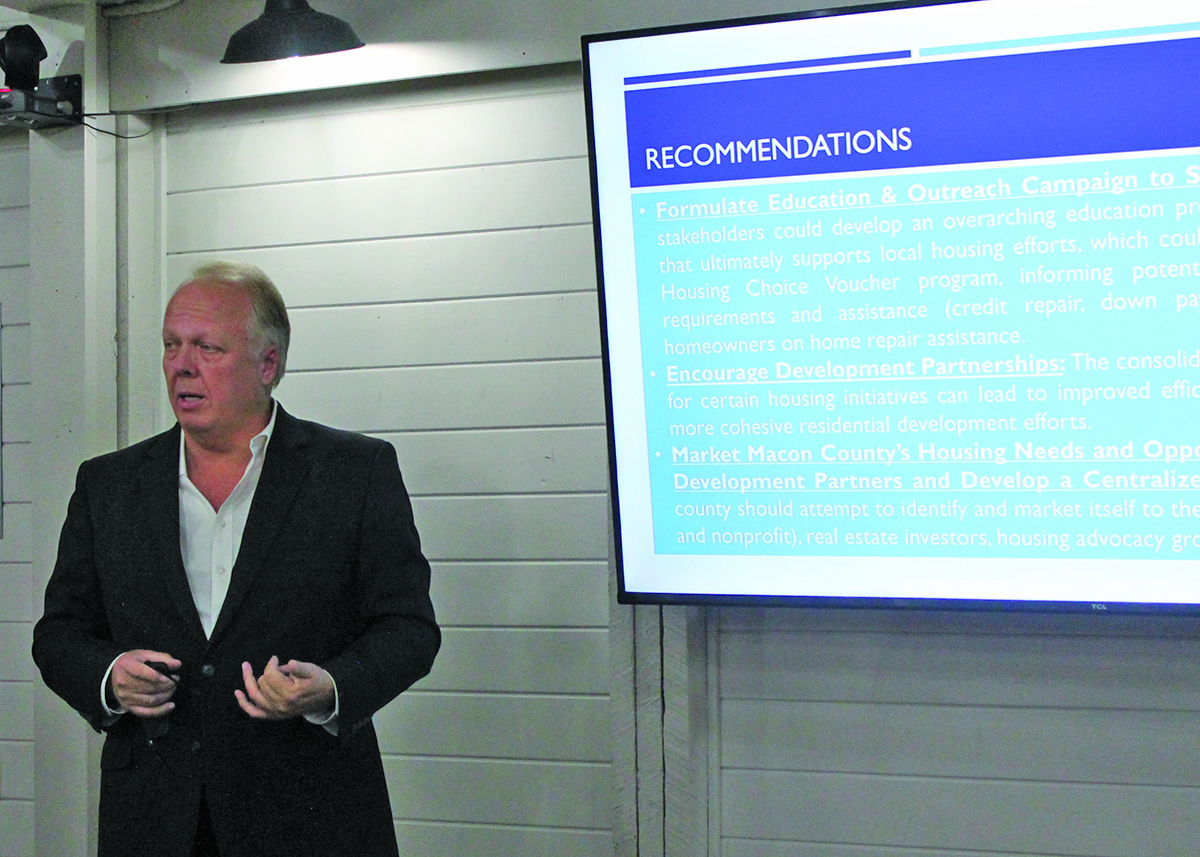
Addressing a packed room at the Highlands Community Building on 4th Street on Wednesday afternoon, Nov. 13, he said the study’s results were a “golden opportunity” to tackle housing problems that have persisted for years.
Funded by Dogwood Health Trust, the Housing Needs Assessment looked into housing price trends, demographics of the area and predicted future trends, then provided recommendations on how the county and local governments could tackle the myriad issues.
The Town of Highlands, and the county as a whole, are heavily focused on tourism for their hiking trails and mountain views. That means a good chunk of their employment base works in the hospitality sectors, where the study notes that many employees don’t make enough to live in the areas where they work.
Bowen said there is a dovetailing of high housing costs and the lack of available housing options which means people are vying for a very limited pool of available rentals, often on the pricier side. The occupancy rate for multifamily rentals in the county was 100% when the study was conducted.
“That’s good for the owners, but not good for the community,” Bowen said.
Bowen said 90% of the rentals in Highlands and 84% of those in Macon County fall under the category of nontraditional rentals, meaning those which are parts of single-family homes, duplexes, units over storefronts, mobile homes and other things.
However, as of the time the survey took place, Bowen said most of those rentals were taken – they only found seven of them that were currently vacant, none of which were in Highlands. The rents on the seven units were all between $895 and $2,000, according to the study.
“If I was making $30,000 a year, I couldn’t afford that,” Bowen said. “If I did have the money, I got seven to choose from. You can see how it’s a challenge to live here.”
Bowen said there were 400 Highlands residents facing either cost-burdened housing, meaning those paying 30% or more of their income towards housing, or severely cost-burdened housing, meaning they paid 50% or more of their income towards housing.
“Where does that leave you for food, healthcare and transportation?” Bowen asked.
Bowen said there were 55 residents of Highlands living in units that could be considered substandard, which was a lower number than some places had, indicating that Highlands had a “higher quality” of housing overall than some areas. He said there were a few hundred people in the county that the study found living in substandard housing.
Later in the meeting, Leslie Manning with Pisgah Legal Services raised the question of whether those numbers be higher than reported due to the presence of people like migrant farmworkers who may not have been counted. “Substandard is putting it pretty mildly,” she said in reference to some places she had seen.
“[The estimate is] probably low,” agreed Bowen. “There are probably people living in mobile homes in serious disrepair.”
The recommendations
To address the high costs of housing, the study recommended programs supporting low-income housing, workforce housing and first-time homebuyers. They recommended doing things such as working with affordable housing development programs, starting a land bank to work with tax-delinquent and neglected properties to become future housing, and offering low-interest or forgivable loans.
He said they should examine ways to make housing affordable, particularly for people in their 20s to early 40s, and for both rent and buying a home. He said they should look at repairing or replacing the substandard housing.
On the housing availability problem, the study recommended expanding density laws to allow for more housing to be built, allowing smaller unit sizes and waiving or lowering government fees.
Bowen said they could get further on the goals by working alongside local employers, saying he’d seen a change in recent years in how employers thought about the issue.
“Employers are feeling the impact of housing,” he said. “They’re saying, ‘what can you do to help us?’ If I did this pre-covid they wouldn’t care. Housing was not on the radar of employers; it wasn’t impacting them. Post-covid, employers are feeling it.”
The study projected growth in residents 65 years old and older in town over the next five years, while other demographics were going to likely decrease, so Bowen recommended making more accommodations for elderly-friendly housing, including maintenance-free housing where they could still live independently.
In the wake of elections that will see new administrations in a few months, Bowen said it remained to be seen what larger governmental bodies would do on housing issues.
He said the study’s results could be a way to kickstart larger change.
“If I were going to start somewhere, make a decision on who’s going to do this,” he said. “This is a big undertaking. If you think local government’s going to solve this, you have underestimated the problem. If I were in charge, I’d think about who’s going to spearhead these efforts. [You could] form a taskforce, form a coalition from advocates for housing from different fields of expertise. There’s a lot of things. You understand the depth of how big the problem is, now you’ve got to do something with it.”