
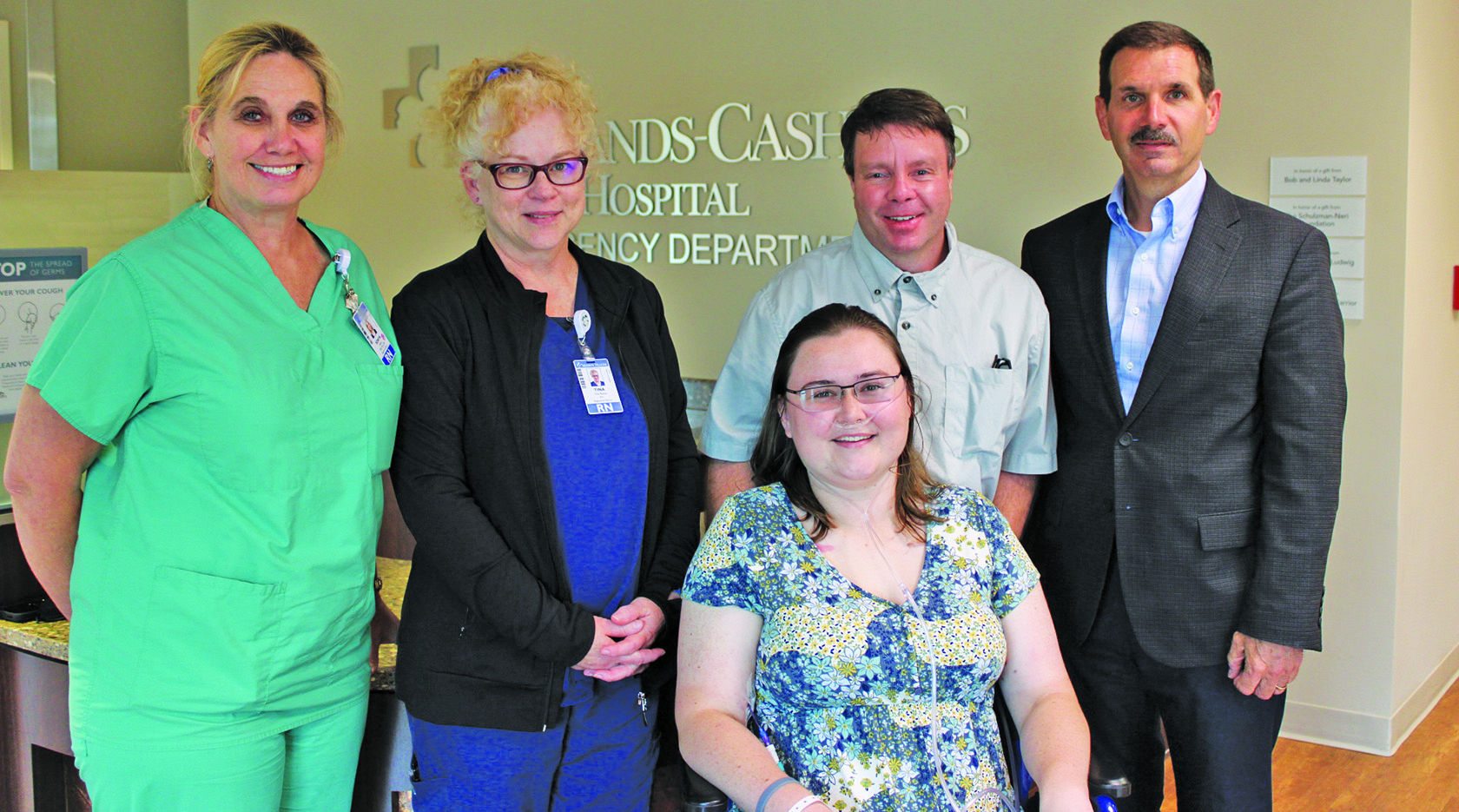
Jordan Vaughn, 22, has been battling dystonia and seizures since she was 14. However, Vaughn credits new treatment at Highlands-Cashiers Hospital with a better quality of life.
Dystonia is a neurological disease similar to Parkinson’s in that it can cause chronic muscular contractions, leading to worn down joints and a literal locked up body. As it wears the body down, it can require replacement surgeries, as Vaughn has already experienced. Vaughn will need another knee replacement surgery soon. It can even prevent the afflicted from talking and breathing.
Not much is known about dystonia. It affects over 200,000 people in the U.S. annually. Experts aren’t sure what causes it, but they believe it is linked to dopamine levels in the brain.
Vaughn’s dystonia spread from the ankles to the wrists within six weeks. As Vaughn’s dystonia progressed, it began taking the ability to move. Vaughn would spend extended periods locked up. As a child she quickly lost the ability to ride bikes, paint, sing, go outdoors, and do other activities.
“It tore my whole life apart,” Vaughn said. “Everything that I thought I was going to be and do… it all got shut down in six weeks.”
As Vaughn rotated through medical facilities in Georgia trying to tackle the disease, the family came to Highlands in 2020. Earlier this year, Vaughn began receiving transfusions of Benadryl and promethazine, or Phenergan, an antihistamine and antiemetic. These transfusions, occurring twice a week for three to four hours a treatment, are followed by a saline IV to keep Vaughn hydrated.
These treatments “unlock” Vaughn and help her live a more normal life at home. The treatments can provide a few days of relief
“With dystonia, it’s all about defying dystonia. Dystonia keeps you locked all the time. To be able to speak is a miracle. To be able to walk to the bathroom is a miracle,” Vaughn said. “There is no cure. There is no set treatment for dystonia, there’s no playbook. Everything we do to beat it is a guess or a Google search in some cases.”
Thanks to these treatments, Vaughn is able to move more independently, get in and out of her wheelchair, and Vaughn has resumed painting. Vaughn will exhibit work in the Fall Colors Fine Arts Show Oct. 21 and 22 at the Highlands Recreation Center.
Vaughn is thankful for her support team, including her family, her caretaker, Toby Whitmire, and the nurses and staff at Highlands Cashiers Hospital. Her rotation includes Sonya James, RN.
“It’s satisfying for us to see something work so quickly in Jordan. As a nurse, you want to see that improvement for your patient and we definitely do see that with her treatment,” James said.
Vaughn said she hasn’t had a bad time up here. The staff knows what Vaughn needs, they are quick, and they are comforting.
“I don’t have to fight to say something because they know me well enough to where I don’t have to. They know the situation,” Vaughn said.
The prognosis for dystonia is not ideal. Vaughn said it tends to progress, worsening over time. However, the team at Highlands Cashiers Hospital is doing what they can to help Vaughn.
“We’re managing it, so the numbers may be wrong. A number is just a number,” Vaughn said.