
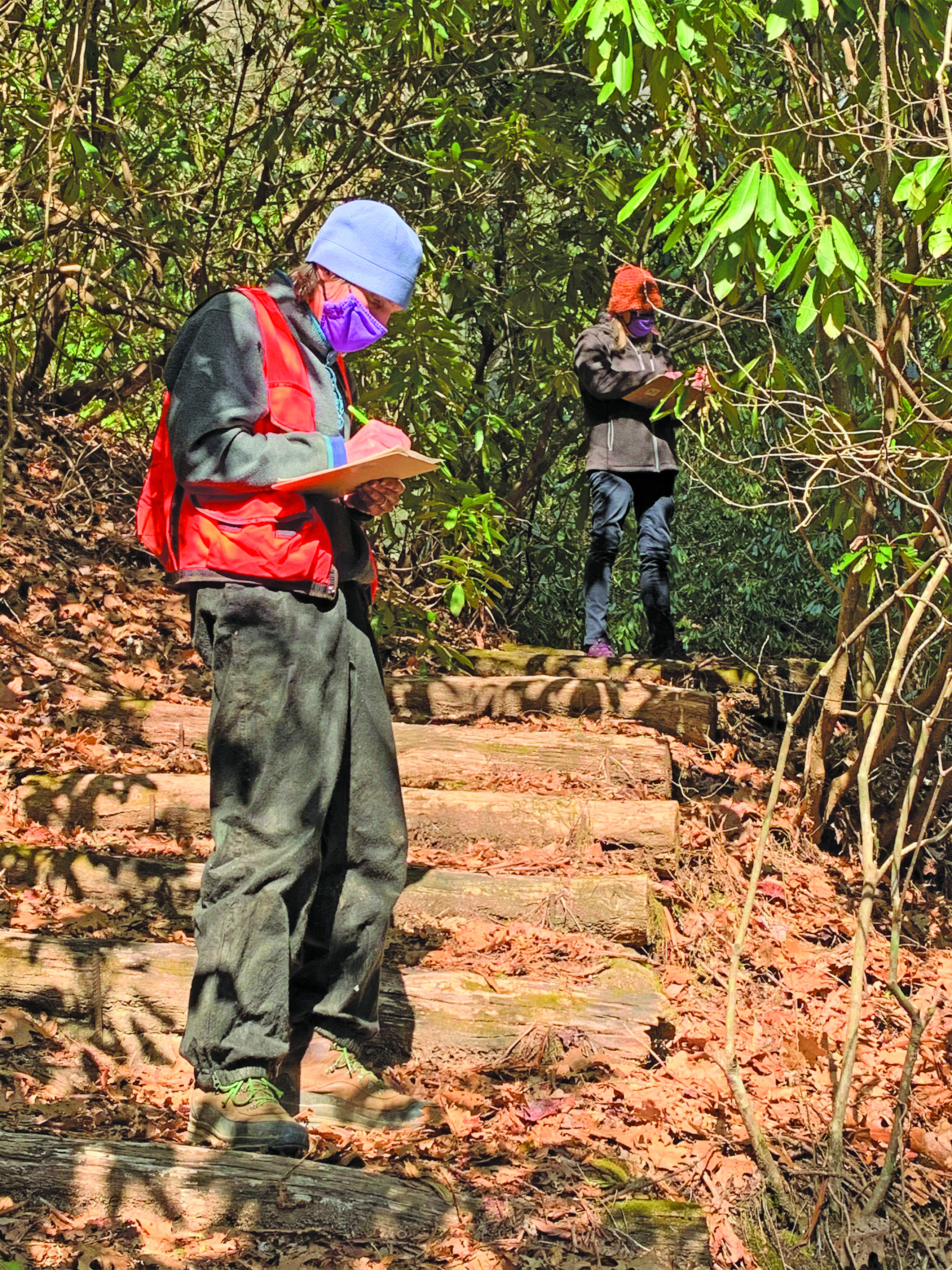
Staff members from the Highlands Biological Station worked with a team of volunteers to protect stands of hemlock trees from the invasive Hemlock Woolly Adelgid during a service project earlier this month.
A team made up of Highlands Biological Station staff members and community volunteers recently pitched in to fight a foe wreaking havoc on Highlands and the surrounding area.
Thanks to support from donor R.B. Haynes, the group was able to locate, diagnose and treat hundreds of hemlock trees and protect them from the Hemlock Woolly Adelgid – an invasive species that infest in and eventually kill the trees.
“Our monitoring and treatment program is truly a team effort and all the credit should go to the volunteers and staff that make it happen,” Highlands Biological Station Executive Director Jim Costa said. “We last took stock of the hemlocks about seven years ago and did a partial treatment in 2017, but since then we have noticed some decline, so we wanted to get back out there this spring.”
The group identified and treated trees on the HBS grounds, along the Coker Rhododendron Trail and the Kelsey Trail. Costa noted that graduate students at the biological station are working to record data regarding a “specialist beetle” that preys on the hemlock woolly adelgid but does not cause disruption to the rest of the food chain.
“In monitoring some of the hemlock sites over a couple of years now there is early data that beetle populations are becoming established, which is good news,” Costa said. “If the beetle successfully establishes a predator-prey oscillation with the adelgid it could mean a better survival rate for the hemlock trees over time. It’s important we keep the hemlocks alive while that research continues.”
Costa added that all the hemlock trees marked as part of the project were measured, treated and their coordinates were logged via GPS.
The hemlock woolly adelgid has been responsible for the deaths of thousands of hemlock trees across not only Western North Carolina but also much of the Eastern United States.
Juvenile HWA search for sites on the host tree, usually at the base of the needles and begin feeding on the tree’s stored starches. HWA remain in the same spot for the rest of their lives, continually feeding and developing into adults. Their feeding severely damages the canopy of the host tree by disrupting the flow of nutrients to its twigs and needles. Tree health declines, and mortality usually occurs within a few years.
There are commercially available pesticides that kill the hemlock woolly adelgid, but Costa recommended seeking the advice of a licensed pesticide applicator.
“Obviously, we do not advocate for the widespread use of pesticides, but there are cases where you have to break out the big guns,” Costa said. “Because of that, it’s important to understand how to properly apply the pesticides to the tree itself while also taking into consideration neighboring vegetation and local water sources.”
Along with protecting living hemlock trees in and around Highlands, HBS staff members also worked to collect data from dead trees that presumably died as a result of hemlock woolly adelgid.
“All of the data is important as biologists and ecologists look at the long term effects that the adelgid has had on the hemlock population,” Costa said. “How the ecosystem responds after a massive tree decline is a question that can’t be answered now and may not be answered for many years – centuries even.”
Costa added that it’s also impossible to know how hemlock decline will effect other species, both plant and animal.
“It goes to show how Earth is still such a little-known planet, even in our own backyard,” Costa said. “Issues like the rise of the emerald ash borer and the hemlock woolly adelgid will keep scientist busy for lifetimes.”
With the help of other interested groups, such as the Highlands Cashiers Land Trust, Costa sees a future where hemlocks continue to be protected and monitored in Highlands for future generations to enjoy.
“We work closely with the land trust and they are a great resource when it comes to identifying and protecting stands of hemlocks,” Costa said. “We battle invasive species, not just the hemlock woolly adelgid, but also invasive plants, animals, lichens, etc. Our organizations have a great working relationship and a common goal of preserving the ecosystem that makes Highlands so unique.”