
Researchers with the Highlands Biological Society are watching and listening to the abandoned mines littered in the high, steep hills of the Plateau, for data they hope will help track bat species in the mines.
They have microphones recording at various locations near the defunct mines, which serve as homes for bats these days. The microphones record which bats are in which of the mines.
Like other Highlands Biological Society efforts monitoring the wetlands and looking at bird migratory habits, this is a long-term effort that doesn’t yield immediate results – the researchers say their goal is to collect data over a long time to find out patterns.
Reagan Jarrett, a research assistant with the Highlands Biological Society, and Dr. Rada Petric, faculty at UNC Chapel Hill and the Director at the Institute for the Environment at the Highlands field site, say their goal is to try and preserve bat species, particularly to save them from White Nose Syndrome. Described as “like athlete’s foot for the face,” White Nose Syndrome, or WNS, is a fungus that grows in the cold and damp places bats hibernate, infecting and eventually killing them. There is no known cure.
“Some species have lost 90% of their population because of white nose syndrome,” Petric said.
The bats are useful because of the way they eat insects that would otherwise be preying on native plant species. “They almost eat their body weight in insects every night. It’s really cool because they are a natural pest control group,” she said.
She added that North Carolina is “really special” for bats.
“We have the most bat species east of Texas – there are 17 unique species. Highlands has 13. Several of them are listed as federally endangered,” she said, naming Northern Long-eared Bat and the Tricolored Bat were both considered big risks in the area.
Jarrett and Petric are conducting the research in what they say is the least intrusive manner possible with their remote microphone sensors.
“There’s no physical contact with the bat,” Petric said. “It’s using remote sensors with an acoustic recorder. Every bat has a species-specific signature, the way they vocalize, and you can identify what species – it’s really cool to be able to study without physical contact and extract a tremendous amount of data. We want to study and understand how the populations are doing.”
Every night the machines pick up noise in or around the mines from 30 minutes before sunset to 30 minutes after sunrise the next morning.
“We get information on when they’re going into deep sleep and then when they’re coming out,” Petric said. “If we’re getting a ton of calls for northern long eared, we know there must be a stable population here, which is great.”
Day at the mine
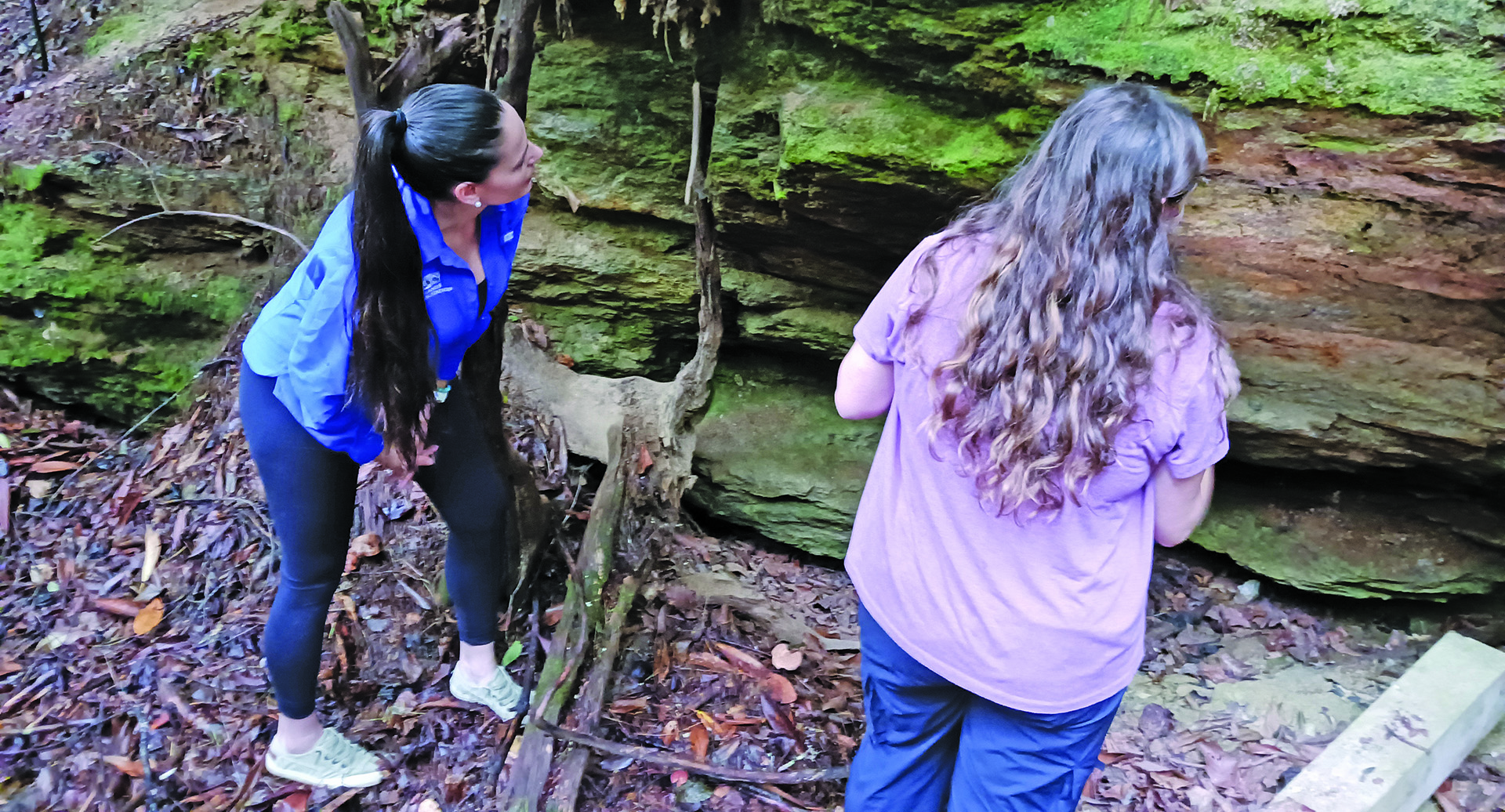
The researchers met in the back country on Bull Pen Road, where the abandoned mine sits, on a gray Thursday morning, Aug. 8.
It wasn’t immediately evident where the mine was – the sides of the road were steep slopes going up and down on either side. Jarrett and Petric made the short walk up an almost vertical slope. Stepping over twisted roots and trying not to lose my footing on the still-slick ground from rain the previous night. None of it was an issue for Jarrett or Petric, who were able to walk up at a brisk pace with ease.
The mine in question was closed off by authorities, so researchers couldn’t go in. It was a small hole in the ground now barred off. The bars are horizontal because it’s easier for bats to fly in and out of them that way.
“You can’t get in there unless you’re a tiny child,” Petric said. “No one is sending a child down there. When the bars were vertical, the bats would crash into them. Since they’re horizontal, they can fly out.”
Jarrett said this was once a mica mine. “It was a big industry in the region.” Later, when we got down to the road again, she found some shards of mica lying in the gravel as if proving her point.
On the days they do go in the mine, they do so in full body suits, rubber boots and gloves and they measure the depth of the mine and look at the temperature, to record how the bats are living.
Jarrett, who just graduated school a year ago, said she’s glad to have the job with HBS.
“It’s been a good opportunity to learn about the importance of bats,” she said. “It’s very rewarding, a lot of fun to get to explore the natural parts of this area, and then also understanding the way that interacts the species in this area, and why we should preserve them.”
“And I just love bats – bats are the coolest thing ever,” Petric chimed in. “And I want to collect as much information as I possibly can.”
The data so far
Bats hibernate depending on the weather – when the insects they feast on are gone for the winter, the bats go into hibernation to save energy, not emerging until the bugs start to come back when the weather warms. While hibernating, though, they become more susceptible to WNS.
As the world heats up with climate change, the hibernation schedules may change. If it stays warmer for longer, the bats may stay out longer.
“I wonder if that could help bats long term, if that could be one positive thing about climate change,” Petric said. “If it stays warm, they are never going to have to go back into hibernation, and they wont be influenced by the fungus.”
“It might disrupt everything else about their food,” Jarrett said.
“Right, everything else, but I’m not sure,” Petric replied. “That will be really interesting.”
“Bats in Florida don’t have to go into hibernation,” Jarrett said.
“Even some bats in coastal North Carolina don’t have a hibernation season,” Petric added.
With the mine closed and nothing more to do, they finished up their collecting of the bat sounds and hiked back down to the road, where we parted ways – the day was still young, and they had other mines to go and check.
“We recorded 80 some gigabytes, so several thousand calls happening – because the data collection is for the entire month, every night, for several hours,” Jarrett said.
Petric said they’d found evidence of Tricolored and Northern Long-eared bats in the mine for the past month.
“Which is exactly what we’re looking for, which is great, we’re really excited about that,” she said. “This is going to be a really good site for them. Their population is going to start increasing.”