
The Cashiers Historical Society hosted its annual Jan Wyatt Symposium last week. The symposium provides a deep dive on a relevant Cashiers topic as selected by the Cashiers Historical Society. CHS’s theme this year related to the history of tourism to the area.
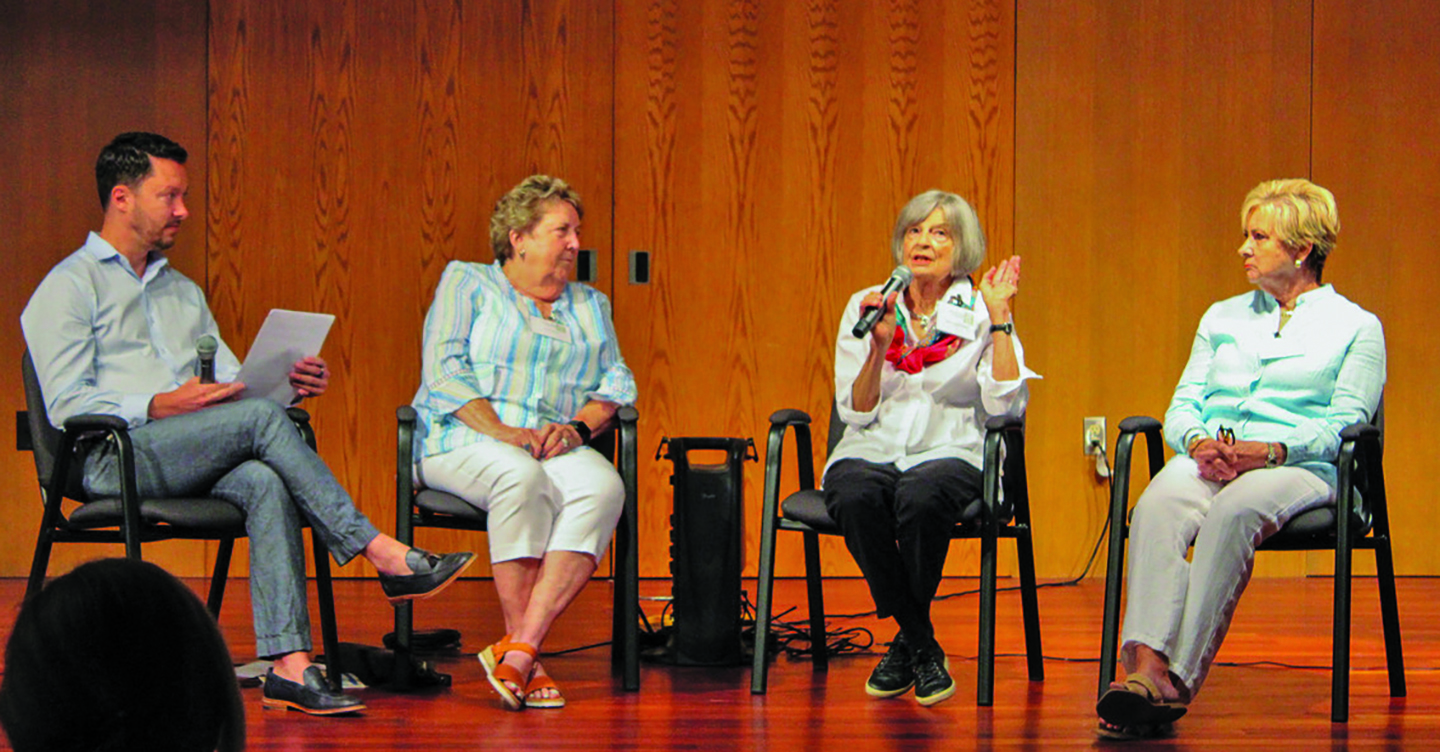
The symposium featured the history of the area delivered by Col. Bob Carroll, a dive on the importance of tourism led by Jackson County Tourism Development Authority director Nick Breedlove, and a roundtable with three former tourism business leaders. Notably, the symposium discussed how Cashiers got to its present status and pathways forward by looking at the past.
Carroll, who gave a similar though more detailed presentation at last year’s Mountain Heritage Lecture, spoke about the people that came together to form modern day Cashiers.
Carroll began with geological history, saying the mountains can trace their start nearly 200 to 300 million years ago. Indigenous peoples likely began arriving between 12,000 and 30,000 years ago, where they encountered lush buffalo hunting grounds and would thrive until the 1500s. Hernando de Soto, a Spanish colonizer, first trekked through North Carolina between 1539 and 1545. De Soto and his soldiers found few riches, but in their wake they left a trail of war and suffering with Indigenous populations they encountered.
In 1763, Carroll said our area was bisected by the Proclamation Line, which forbade British colonists from moving past the Appalachian mountains. However, with the American Revolutionary War around the corner, that goal post did not last long.
Carroll said the Nortons and Zacharys were some of the first white settlers to the area.
Barak Norton arrived in 1826 as an early homesteader. He lived to be 96, although looking back at his life he had a few regrets. One regret was his possession of enslaved people, another was telling American troops where Indigenous people could be found hiding, and a final was the Civil War which cost him three sons.
Col. John A. Zachary arrived at Cashiers in the early 1830s, becoming an early “founding father of Cashiers,” said Historical Society executive director Amelia Golcheski.
John Zachary’s son, Mordecai, built on the newly developed Tuckaseigee Turnpike, which opened trade to the region. Logging was a huge commercial industry, only to later be replaced with tourism as the driving force. With trade flowed in people and economic development, and shortly thereafter railroads came to the region.
“People were coming in and out of these mountains,” Golcheski said. “The growth of railroads and the success of the logging industry brought people up here.”
Golcheski explained that eventually entrepreneurs would think leisurely resorts would drive economic opportunities. Led by a group of Pittsburgh entrepreneurs, the Toxaway Company was established in 1895 to mine. The Toxaway Company then began building a series of summer resorts. The Fairfield Inn was built in 1896 with Sapphire Inn following in 1897. The Toxaway Company was also responsible for damming Lake Toxaway.
High Hampton was the first inn in Cashiers, although it burned down prior to the Great Depression, offering new construction jobs in a rocky economy.
“Tourism is the one constant in shaping the face of Cashiers,” Golcheski said.
That trend has continued, as Breedlove explained. Breedlove said tourism kicked off in the area in the late 1800s. By the 1900s, the area was heavily promoting Whiteside Mountain, fly fishing, and other aspects people think of when visiting our area.
“We’re really not doing anything new with modern tourism,” Breedlove said. “We’re still finding ways to get people up here.”
Jackson County is ranked number two out of 17 counties in western North Carolina for tourism, grossing about $452 million a year and over one million visitors each year. Breedlove said the tourism here promotes nearly 2,400 jobs.
The big challenge is moving forward in a sustainable way. Jackson County is around an 80 percent occupancy capacity in October and July, so Breedlove’s department seeks ways to promote tourism during the “secret season.”
“Crowds thin out and you have the restaurants and hiking trails to yourself,” Breedlove said. “We’re trying to minimize impacts so we can make this a great place to visit, and we can keep it great for the people who live here.”
The discussion then moved into a roundtable led by three women who lived in and worked in Cashiers for their lives. These three women, Sandy Fugate, Nancy Swann, and Linda Rogers, discussed their family histories and the impacts of tourism on their families and early lives.
Fugate can trace her lineage to the Nortons and Zacharys. She was born in Sapphire, and her parents worked at Fairfield Inn. Her father was the chef and her mother was an inn caretaker. Swann’s parents started The Carolina Mountain Shop in 1946 and ran it for over 50 years. Rogers was born in Glenville and she followed her parents’ footsteps, working at High Hampton in the 1960s and later at Fairfield Inn in the 70s.
All three ladies saw the area change over the years. Workers at inns did any tasks needed. Guests would frequently return every year to celebrate such a welcoming experience.
“The inns started a family tradition,” Rogers said. “There was good service and the temperature was cool. It allowed a true vacation for families.”
However, the three also saw the pains of the off season on working families. When the season slowed, work often slowed and families had to sell additional crafts or otherwise be creative in their finances.
When asked at what point Cashiers changed, Fugate said the biggest change might have been the boom in realtors. Fugate said she remembered when there were only two real estate agents at one point. Swann and Rogers pointed to additional construction as a primary factor of change.
The three also speculated on problems facing the Cashiers area and ways moving forward. They said infrastructure will be a big challenge.
“There are still the same two roads into the area as there were in 1946,” Swann said.
Other potential problems include health care, housing, the power grid, and water and sewer, along with increased traffic.
“We’re all going to need more employees going forward, but it’s getting harder for them to commute,” Rogers said.