
Highlands has come a long way in terms of handicapped accessibility over the past several years, but as the board of commissioners learned on Thursday, there is still a ways to go.
The board received an update on the in-progress development of an ADA Transition Plan by representatives from the planning department and consultants from JM Teague Engineering in Waynesville.
JM Teague representative Candace Hladick explained that the Americans with Disabilities Act went into effect in 1990 and is regularly updated on the federal level. In the ADA, there are certain requirements set forth related to businesses, government agencies and municipalities.
“All municipalities with 50 or more employees must complete the current self-evaluation and comply with the recommendations set forth in the plan,” Hladick said. “Specifically, we came to Highlands and we looked at common barriers to accessibility.”
Hladick noted that the first step in the transition plan is the designation of a town ADA coordinator. Town planner Michael Mathis was selected to fill that role for Highlands going forward. The ADA coordinator Investigates all complaints related to ADA compliance, oversees town policies and procedures, develops an ADA public notice and a defined grievance policy.
JM Teague developed a public survey related to ADA accessibility and received more than 90 responses.
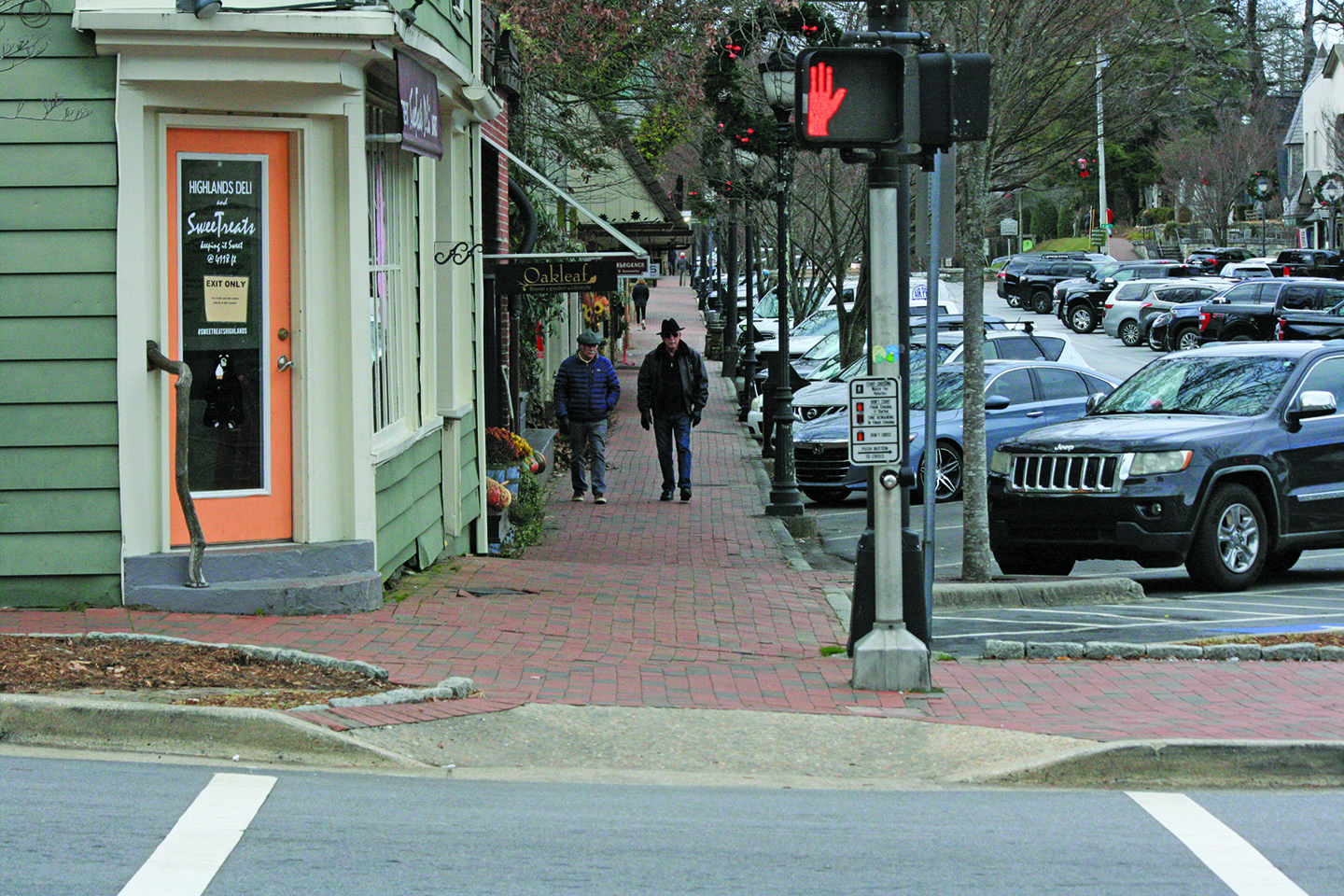
“Some of the things we heard, 48 percent of respondents said they would not know who to contact at the town if they needed assistance with ADA accessibility,” Hladick said. “Overall, town facilities were viewed as accessible, but respondents noted issues related to curb ramps, crosswalks and the number of handicapped parking spaces on Main Street.”
Mayor Patrick Taylor asked Hladick if the number of ADA parking spaces on Main Street met the current requirements and noted that when Main Street was repaved last year the NC Department of Transportation was tasked with ensuring the proper number of ADA accessible spaces was met.
“What we found was there was one parking space between 1st Street and 3rd Street that was removed during that paving project,” Hladick said. “It was most likely a simple oversight, but that space will need to be remarked as an ADA space.”
Hladick noted that one commonly mentioned site with ADA issues is the Highlands Dog Park behind the Rec Center. The current parking area is gravel, the path into the park is uphill and not wide enough to meet ADA requirements.
“We had multiple people respond that they would love to use that facility, but they can’t find a way to access it,” Hladick said.
During the self-assessment process, Teague representatives reviewed more than six miles of sidewalks, 182 curb ramps, 11 town buildings, four parks and one school zone. Hladick noted that Teague found 68 percent of Highlands’ curb ramps are not ADA compliant. More than half of the non-compliant ramps simply need ADA approved truncated domes, which alert sight-impaired pedestrians that they are walking into a lane of vehicle traffic.
“If you prioritize putting truncated domes in, you will take a big step toward overall compliance,” Hladick said.
Hladick noted that many of the recommendations in the transition plan are low-cost items that can be done in a short amount of time. The plan breaks down projects by immediate needs, 1-2 year needs and long-term needs.
“This plan is meant to show you as a town what you need to work on,” Hladick said. “As funds become available, these projects can be done and compliance can be reached. It isn’t something that has to be done tomorrow, but rather over a defined period of time.”
The next step in the transition plan will be for the town to approve Mathis as its ADA Coordinator and pass a resolution accepting the ADA transition plan. The board asked Hladick to work with town manager Josh Ward to draft the resolution and bring it back before the board at its December meeting.