
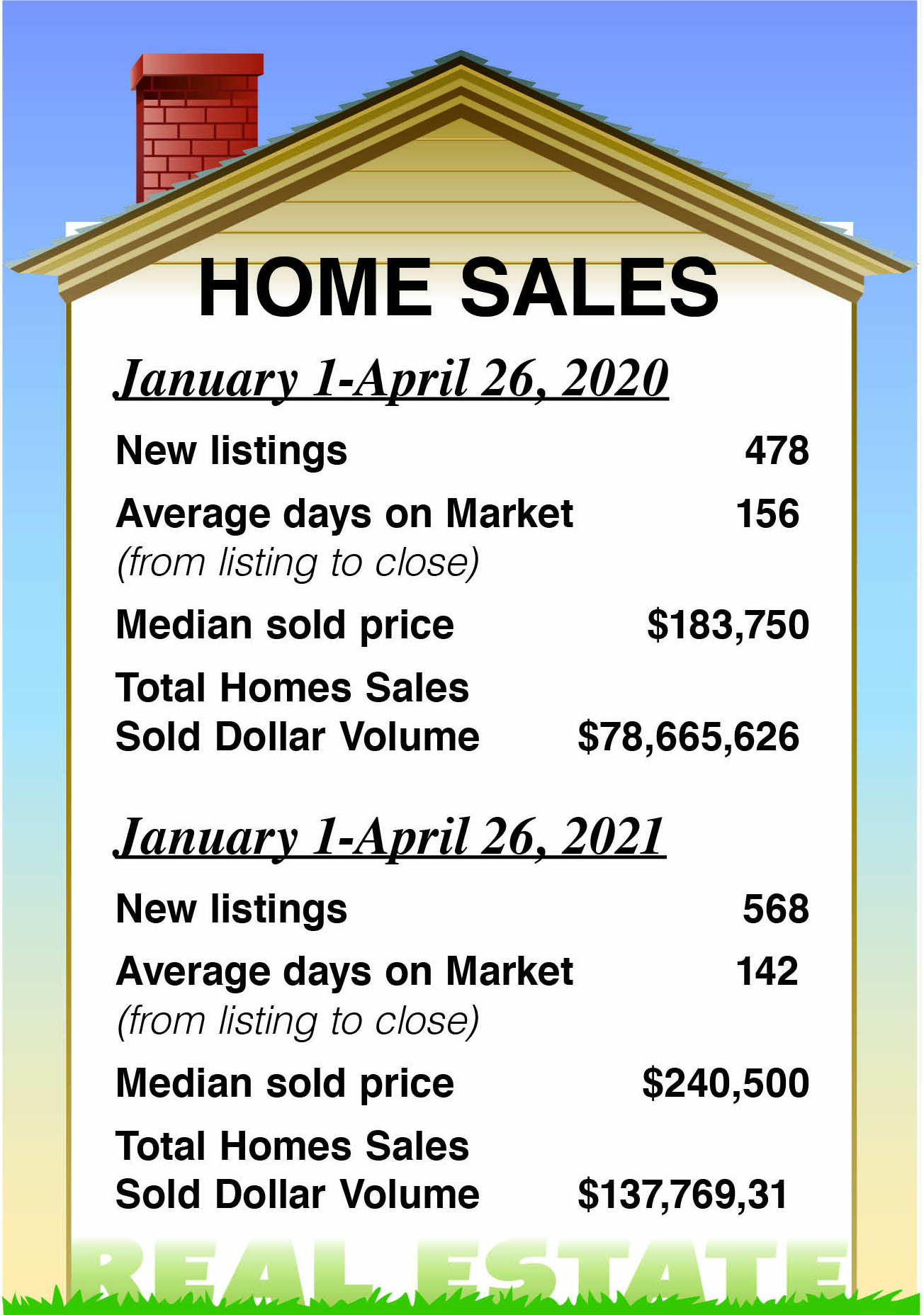
Real estate statistics for Macon County.
Low interest rates coupled with people making work and lifestyle changes due to COVID-19 has resulted in a fast-paced real estate market in Macon County. If you are a buyer, be ready to jump on the home of your dreams, because it could be sold in just a few days.
Sellers are getting multiple offers and seeing their properties go under contract within 24 hours, according to John Becker, broker/owner of Bald Head Realty. Last week he listed a house at 5:30 p.m. and three hours later had four offers. “I don’t see that changing,” he said. “I’ve never seen anything like it.”
For a seller, that means they may get several people bidding on their property and usually end up getting above listing price. Becker said some buyers don’t have the heart to get into a bidding war, so they back out of competition. “But it’s happening with every one of them,” he said.
Currently, listings stay on the market an average of 142 days, which includes the time from listing until closing. That’s down from an average of 156 days on the market during the January 1-April 26, 2020, time period. If a home is being financed by a lender, the loan typically takes anywhere from 30-35 days for full approval.
Even in the Highlands-Cashiers Plateau where the median sale price is $600,000, homes are staying on the market an average of only 72 days, according to Julie Osborn, broker in charge of Pat Allen Realty Group’s Wildcat Cliffs office in Highlands.
“Our market has seen a dramatic change in just the last 12 months. We have seen what has been a consistent and predictable buyer’s market dramatically swing into an unpredictable seller’s market at a record pace,” she said.
Osborn said the inventory in the Highlands-Cashiers market typically hovers around 10-12 months of supply, but that has decreased to approximately 1.8 months of supply during the past year. “The market is strong and we are now facing the dilemma of not having enough homes to sell based on the demand as more and more people want to relocate to our plateau.”
Becker said he’s usually working 40-45 listings, earlier this week he had six. “We don’t have enough inventory. It is a seller’s market,” he said.
It’s a similar situation across the state. Osborn said North Carolina’s year-over-year inventory is down 64%, and the state has the third lowest inventory in the country behind Utah and Idaho.
The reduced inventory also means people selling their houses are often having a hard time finding a new place to live. Becker himself is an example of that. He owned a two-bedroom house in town valued at about $165,000 and listed it for $200,000. Since it sold he’s been living in the basement of his office building on Pine Street. “There’s nowhere to go,” he said.
Highlands and Franklin remain popular markets for second-home buyers who traditionally pay cash; however, with the low interest rates, Osborn is seeing more people in the Highlands area financing their homes.
Paying cash gives buyers the upper hand when it comes to a bidding war. A cash sale is attractive to sellers, especially if they need to make a quick move and not wait for a buyer’s loan to be approved. From Jan. 1 – April 26, 2021, 162 sales closed with the buyers paying cash. During the same time period last year, there were 127 cash sales.
Osborn said anything under $1 million in the Highlands-Cashiers market that does not need a lot of repairs will sell quickly. Throughout the county, first-time homebuyers and investors look in the $150,000-$200,000 range, with $200,000-$250,000 being the next step up.
Osborn and Becker both said they are seeing buyers from other areas, who want to make lifestyle changes, and now that more people are working remotely due to COVID, they can choose to live anywhere they want. So, it’s no longer just retirees looking to come to the mountains.
In his promotional videos on YouTube, Becker proclaims Franklin as “the place everybody wants to be.” He does point out though, that people who work remotely need reliable, fast internet service. That is a concern the county leaders continue to address.
Buyers are coming from throughout the Southeast as well as the Northeast, Midwest, Michigan, and even California. Osborn said COVID has been a driving factor in buyers from outside the area. “People want to feel safe. They want to feel they are in an environment where they can be outdoors enjoying nature and fresh air. They are tired of traffic, pollution, crime, taxes and restrictions. People are seeking freedom, and our plateau offers such a great lifestyle and a safe haven from so many of the negatives our big cities are experiencing.”
She said the Highlands-Cashiers market is all about lifestyle. Whether it’s a rustic cabin in the woods or a contemporary home on the side of a mountain “people want a place where they can feel a sense of peace with nature and feel a real sense of overall security.” Some of the planned neighborhoods under construction, especially in the Cashiers area, cater to that lifestyle with amenities such as on-site organic community gardens, trout ponds, guided foraging, private hiking trails, chef-taught cooking classes, neighborhood concierge services, and even “glamping.”
Outlook
Osborn believes the Highlands-Cashiers market will remain strong and continue to grow because of the small-town feel and low-key lifestyle people are seeking. “We’re a great place to be right now,” she said.
Becker also thinks once people discover an improved lifestyle here with a slower pace, friendly people, and nice seasonal weather, they will want to stay. “Make hay while the sun shines,” he said. However, he does have concerns about the overall market.
He said while the real estate market is cyclic with natural ups and downs, the risks come with the loss of jobs and people not being able to make their mortgage payments. Additionally, landlords who cannot evict non-paying tenants due to COVID may be at risk of defaulting on their investment properties because they aren’t getting the income they need. If the economy does not recover and people don’t have jobs, he fears a “tsunami of foreclosures” that may be similar to 2010 or worse. “I’m just praying to God that doesn’t happen.”