
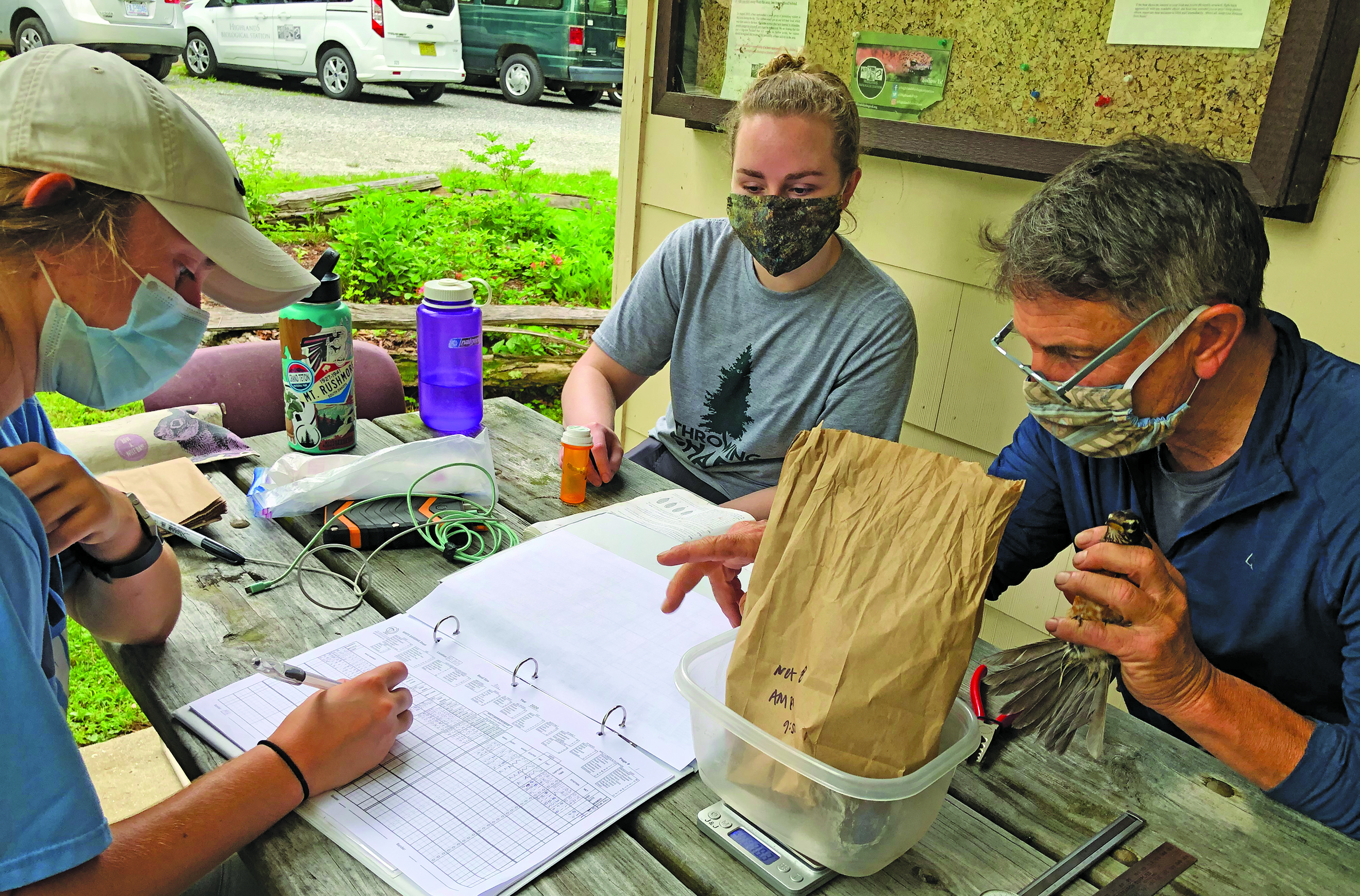
As part of its continuing partnership with Western Carolina University, and in conjunction with an international effort, the Highlands Biological Station has initiated a bird banding project for birds that call the Highlands area home.
At WCU’s Macon County research facility, staff described the importance of monitoring bird populations, which include educational opportunities for both volunteers and visitors.
Jason Love, associate director of the Highlands Biological station said civilization has taken its toll on local bird populations.
“Bird populations in North America have declined,” said Love. “The proliferation of development displacing habitat, predation by feral cats, and collisions with wind turbines, communication towers and buildings with glass windows, along with pesticides, have taken a toll on birds and other wildlife. Research is needed, not only to better understand the underlying causes of these declines, but to find ways these alarming trends can be reversed.”
According to Love, the biological station is entering into a bird-banding partnership with Southern Appalachian Raptor Research.
Southern Appalachian Raptor Research operates several banding stations as part of the Monitoring Avian Productivity and Survivorship Program. The bird-banding will take place approximately every 10 days through early August.
Nonharmful mist nets are used to momentarily capture birds and allow handling.
“The welfare of individual birds is the first priority,” Love said. “Extracting birds from the nets and handling and collecting biological data is done with great care by trained staff and volunteers.”
Love said by phone, the banding tables are set up at the Highlands Biological Station, and in the future, once COVID-19 precautions are lifted, avian educational programs will be held in conjunction with banding. Biological data collected from birds includes age, sex, signs of disease or injury and wing measurements.
Birds will be fitted with U.S. Geological Survey aluminum bands that have a unique number on each one, so individual birds can later be identified. According to the USGS, birds are good indicators of the health of the environment, with the status and trends of bird populations critical for identifying and understanding many ecological issues and for developing effective science, management and conservation practices.
Highlands Biological Station Executive Director Jim Costa was up with the sun working with staff on the project, collecting data and banding birds. He said the bird banding project will help in their efforts to aid in sustaining a declining bird population in the area.
“This has been an ongoing national project and Highlands as long been an interesting area for birds,” Costa said. “And we’ve never really had a monitoring system set up for these birds. It’s every compelling and a real educational opportunity.”
At the end of the year Costa hopes to have a real data set in chronicling the variety of birds they’ve banded during ongoing banding sessions throughout the summer.
Of course, it’s seasonal, running from spring through fall,” he said. “We’ve had four-or-five banding sessions so far and we’ve documented about two dozen different species of birds during those sessions.”
Costa said the high canopy birds are difficult to capture and band using misting nets.
“It’s the ground birds or the low-flying birds we are able to capture and band,” he said. “We have some repeated visitors, those birds we’ve already banded.”
Plans are in the works to apply for continued funding to make the bird-banding project an ongoing study.
Funding for the bird banding project was made possible by the Highlands Biological Foundation.
The Highlands Biological Station is a multi-campus center of WCU, forming an educational and support partnership in 2019 and made up of a field station complete with laboratories and classrooms, a nature center, and a botanical garden and pond. The 23 acres includes publicly accessible trails and boardwalks.
For more information about the Highlands Biological Station, including its nature center and botanical garden programs, visit highlandsbiological.org.