
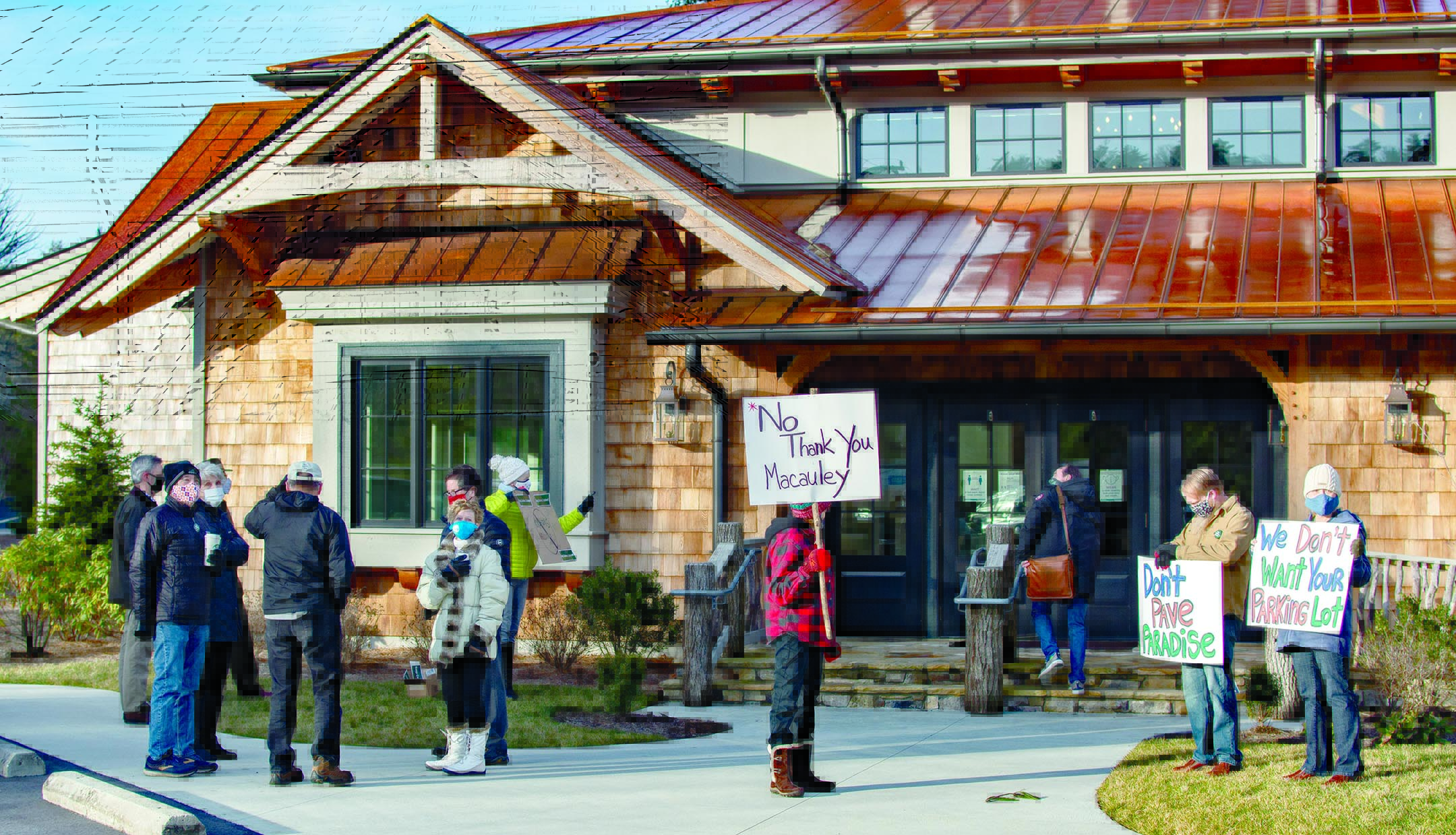
The Cashiers Area Community Planning Council heard arguments over legal standing for the proposed Cashiers Hillside development project on Jan. 6, setting the stage for a discussion on the merits of the project on Jan. 25.
The Jan. 6 meeting allowed neighboring property owners, project stakeholders and members of the community to make their case to the board for legal standing, meaning they would be able to participate in the Jan. 25 meeting through testimony and the presentation of expert witnesses in opposition to the 55-acre proposed development.
The threshold for legal standing in the upcoming hearing is relatively strict, requiring applicants show a unique harm would be inflicted upon them by the development if it were constructed as proposed.
“For the purposes of those coming up, it takes more than alleging,” said Jackson County Attorney Heather Baker. “Has she shown uniqueness, and special damages to her property as opposed to someone in Cashiers in general?”
The meeting began with the presentation of a stipulation agreement between Asheville-based attorney John Noor, who represents five individuals and groups opposing the development, and Craig Justus, also from Asheville, who is representing developer Stephen Macauley.
The stipulation, a legal agreement that indicates the two attorneys reached an agreement ahead of the hearing to allow certain parties to have standing in an effort to expedite the hearing process, provided four of Noor’s five clients with legal standing – environmental nonprofit The Chattooga Conservancy and Cashiers residents Yvonne Johnson, Laura Moser and Jeannie Menge. Noor’s fifth client, the Gana Sita Property Owners Association, will be allowed to participate in the hearing as a witness but will not receive legal standing, per the terms of the stipulation agreement.
The attorneys agreed to review Johnson’s application as an example of the types of damages alleged that would qualify for standing in the case. Johnson, who owns a home on Bustle Lane on a piece of property abutting the proposed development, expressed concerns about possible traffic congestion, risks of landslides and potential stormwater runoff harming her property.
During this phase of the process, the merits of these claims were not scrutinized as heavily as they will be during the Jan. 25 hearing and any subsequent hearings that might occur. Instead, the arguments for standing hinged primarily upon the uniqueness of the potential damages alleged by the applicant.
Johnson’s claims mirrored many of those presented by Noor’s other clients, and the council agreed to accept the stipulation as presented by the attorneys.
Parties with standing
Beyond the five parties represented by Noor, 24 other individuals and organizations made a case for standing to the council during the Jan. 6 meeting. Of those 24, seven more were granted standing and 10 others were granted permission to participate as witnesses without standing in the same way the Gana Sita Property Owners Association was permitted in the attorneys’ stipulation. Five applicants were declined permission to participate as witnesses with or without standing, and the remaining two applicants will be addressed at the start of the Jan. 25 meeting.
Sarah Jennings, a Cashiers resident who owns property adjacent to the proposed development, was the first to be granted standing from the board.
Jennings’ property is separated from the development by a small stream and downhill from the main development area. She alleged the construction could possibly harm that waterway, as well as negatively impact her property through stormwater runoff and construction traffic in the 5-10 years it would take to complete the project.
Justus objected to the view that allegations of damages alone were sufficient to grant a party legal standing.
“Damages require some probative evidence of property value decline. The (North Carolina) General Assembly has said this is an area in which you need expertise,” Justus said in response to Jennings’ claims of unique damages to her property. “As a layman, you are not allowed to present evidence in this area. There is no expert here to show damages.”
The council approved Jennings’ application for standing despite Justus’s objections, which set a precedent for other applicants later in the meeting to receive standing as well in an effort to apply a consistent standard across all those seeking to participate.
Steve Johannessen, the second applicant to receive standing, received pushback from Justus on the same grounds as Jennings, The evidence he provided backing his claims of traffic congestion outside his business, which abuts the proposed development, was not provided by qualified traffic analysis experts, Justus claimed.
Regardless of where the barrier to entry was set initially for legal standing, Baker said it was critical for the council to apply an even-handed approach to all applicants in the hearing.
“Putting traffic aside for a minute, I believe Mr. Johannessen testified and characterized some things about his property that were similar to Ms. Jennings,” Baker said. “Regardless of what happens down the road, one of the things that’s most important is your consistency in who you allow to have standing.”
The council voted unanimously to grant Johannessen standing, and granted six additional applicants standing on similar grounds throughout the remainder of the hearing. Cashiers residents Giuliana Kaufman, Brent J. Millis, Jonathan Zachary, Mark and Judy Zachary and Patrick Hurley joined Johannessen, Jennings and the four clients represented by Noor as the only opposing parties currently approved for legal standing.
Participating witnesses
Many of the applicants for standing during the Jan. 6 hearing had claims that were similar to those made by the Gana Sita Property Owners Association, prompting the council to grant them similar status as participating witnesses without legal standing in the upcoming hearing.
These applicants alleged varying degrees of unique harm caused by the proposed development, but either do not own property abutting Cashiers Hillside or had other mitigating circumstances that did not rise to the level of evidence those who attained standing presented.
“The obligation is to show up today with some proof of a link between this development and their property that is unique,” Justus said in response to William Wallett and Suzanne Graham’s application for standing. “I would respectfully ask that we be consistent and allow them to participate as a witness, but not a party with standing.”
Wallett and Graham will be joined by Cashiers residents Deborah and Steven Clark, Mary Ellis, Susan Hamilton, Keven and Connie Hawkins, Jamie and Mark Moran, Jane and Patricia Nardy, Kelly Ryan, William H. Schoeffler and Silverleaf Capital, LLC and Lisa and Glenn Ullman as participating witnesses without standing.
What comes next
The Jan. 25 meeting will be the first public discussion of the merits of the Hillside project before the council, and the proceedings will begin with presentations from the developer about what is proposed and why his team believes it conforms to the regulations governing property use in Cashiers.
“The next hearing is about substance, and the board members are going to hear from the developer and his explanation for how this meets the standards, in their view,” Noor said. “What we don’t know is whether that will take so much time that we get to our side. They put down evidence, and then I get to cross examine witnesses. That can take hours, depending on the experts they have and the kind of testimony they give.”
Noor said he was glad to see the council extend standing and participatory witness status to so many applicants during the Jan. 6 meeting.
“I think the hearing went well,” he said. “It was good the board acknowledged as many folks as they did, and that’s what that hearing was about – determining who would be the right people to have in the room to discuss this.”
In discussing the case to be made in opposition to the development, Noor reiterated previous claims of water scarcity and what he views as shortcomings in the infrastructure plans presented by the developers.
“The questions council members and the community should ask is ‘where is the evidence to prove the elements required for a permit?’” Noor said. “If you have one person pulling water out of the ground, and the ground is hydrologically connected, when someone else starts pulling water you’re both pulling from the same pool. Eventually there’s not enough water to pull for everyone.
“Water is a huge issue, and the developer has presented no information to the county. Where is that information? There is a list of content that has to be submitted with every application, and large chunks of what’s needed are missing. How did it even get to the council?”
The next hearing concerning the Hillside development will take place on Jan. 25 at 9 a.m. The meeting will be streamed live on the Jackson County, NC Planning Department Youtube channel, and the recording of the Jan. 6 meeting can be viewed at any time on their channel as well.