
reporter@highlandsnews.com
Recodify Cashiers held two meetings last week to discuss future changes to the Cashiers Unified Development Ordinance and gauge community feedback.
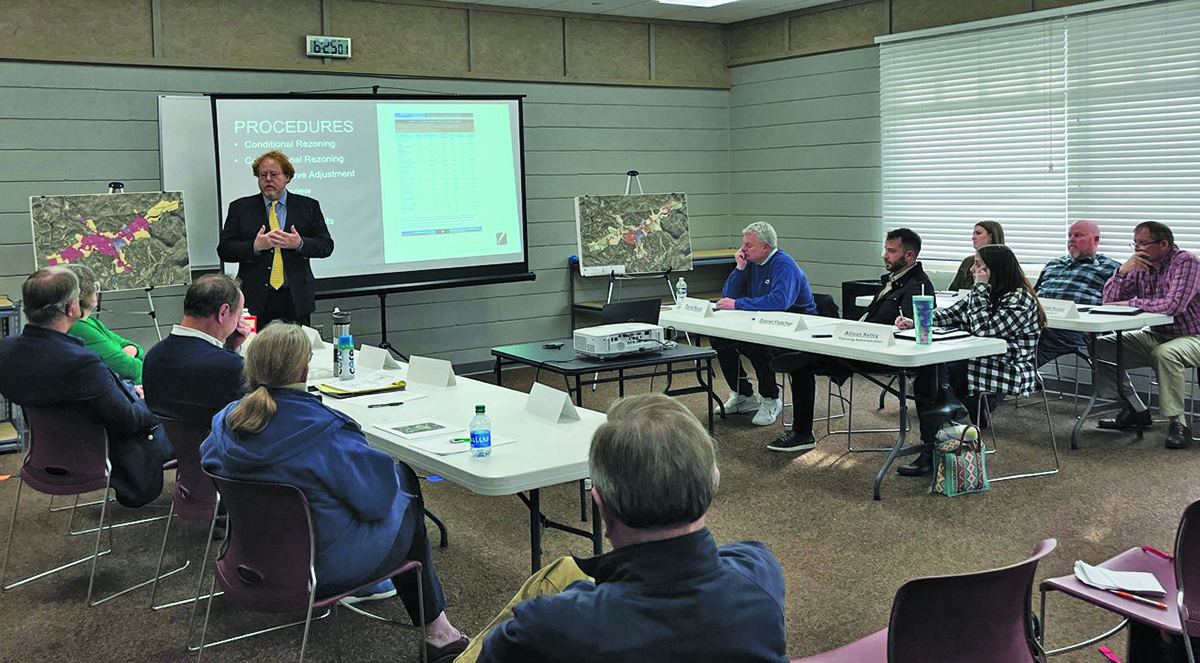
The Wednesday meeting was an official Cashiers Area Planning Council meeting that began with a request for support from Vision Cashiers and continued with CodeWright founder Chad Meadows’ work on the UDO. The Thursday meeting was planned as a community discussion, although attendance was sparse.
Walkability
First, Paul Robshaw with Vision Cashiers presented a proposal to increase walkability in the community and he asked the planning council for support in the form of a motion to be delivered to Jackson County’s Board of Commissioners.
“The campaign we are about to launch is called Walk Cashiers: Bringing Us Together. Our concern is we don’t want to become a short-term rental community where there are all kinds of strangers here and the friends we have aren’t seeing each other,” Robshaw said.
It is a two phase plan for $5 million with support from the county commissioners and Cashiers Chamber of Commerce, as well as the East Kessler, Cashiers Marketplace, and Cashiers Lake developments. It would add about five miles of sidewalks snaking around Cashiers proper and heading to Ingles.
Jackson’s TDA expressed support for the first phase, although their financial support is yet to be determined. Notably, phase one would connect the Chamber to Zollers, Whiteside Brewing, and Wells Hotel, and then head to Buck’s and the Keller Williams building. Robshaw hopes phase one will be complete by the summer.
Phase one also requires the addition of a pedestrian crossing light in front of Zoller’s. The planning council passed a motion in support of the crossing light to relay to the county commissioners.
“It’ll be a really first class attraction to bring
people to Cashiers,” Robshaw said.
Recodification
Meadows then presented work to redo Cashiers’ UDO and notably go to a conditional zoning process, which he hopes will allow the planning council more power and authority, allow for communication between developers, planners, and the community, and streamline rezoning. Meadows hopes the Cashiers Planning Council will review, but not decide on conditional rezonings, but they will still have to decide special use processes.
“All the things that seem to be missing from the special use process are integrated into [conditional rezoning procedures.] There’s a reason most governments in North Carolina use a conditional rezoning process,” Meadows said.
Ideally, the new UDO approaches would help the Cashiers Planning Council be the voice of the community to determine what the community wants, rather than the force sitting through tedious meetings to determine whether or not to send a development to Sylva’s board for approval. They would be the authority writing codes and updating those accordingly.
“We would like you to focus on making sure regulations are properly calibrated and adjusted as needed,” Meadows said. “You’re the keepers of the rules. You’re the arbiters of what the community wants.”
Currently, these processes have few standards set in stone. They trigger quasi-judicial and legislative hearings. As Cashiers is familiar with, the Marketplace development has been in these meetings for a year. They are set to resume Monday and Tuesday at 9 a.m.
“It’s a process that isn’t predictable, it takes a long time, it’s expensive, and it puts a bad taste in people’s mouths,” Meadows said.
He hopes updating the UDO will help determine the building thresholds the community wants to see. If developers allowed community discussion and brought forth criteria that meet the thresholds, their proposals would likely be approved.
With a conditional rezoning, only developments over 20,000 square feet and/or generating at least 3,000 traffic trips a day will be subject to conditional rezoning. Most developments would be conventional zoning, but some special use developments would still be included.
Some members of the Cashiers Planning Council feel they already lack authority in development matters due to the special use process. Planning member Douglas Homolka said power isn’t his goal, but he wants to ensure Cashiers has a voice.
“I’m not looking to ensure the planning board has authority. I’m looking to ensure the community has a say. The only say they have right now is through these meetings (special use),” Homolka said.
As design standards are reworked, all of Cashiers current districts will be changed. Meadows also said the new UDO draft would have four districts compared to Cashiers’ current two. Cashiers currently has general commercial and village commercial zones. Meadows proposed residential, non-residential, mixed use, and conditional.
Meadows will continue working on the UDO. He said he hopes it will be codified by June.