
Charges relate to Meadows’ refusal to appear before committee tasked to investigate Jan. 6 capitol attack
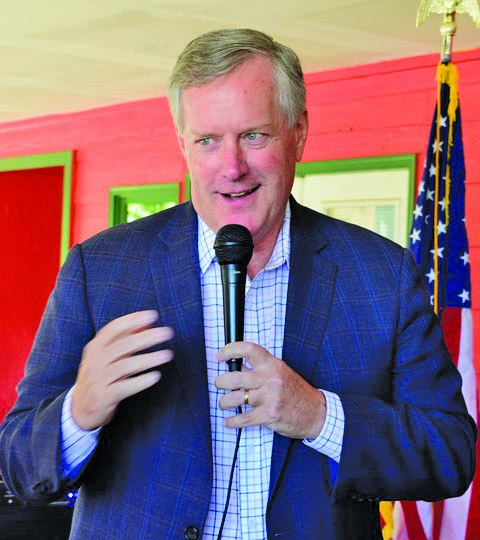
File Photo Mark Meadows speaking at a past GOP convention in Macon County.
As Congress’ investigation into the events that occurred at the United States Capitol complex on Jan. 6 move forward, former North Carolina Congressman and White House Chief of Staff Mark Meadows has found himself in the crosshairs of the congressional committee assigned to the investigation.
On Dec. 14, the United States House of Representatives voted to hold Meadows in contempt of Congress and forwarded their recommendation to the United States Justice Department.
The charges against Meadows relate to his refusal to cooperate with a subpoena to appear on Dec. 8 before the United States House of Representatives’ Select Committee to Investigate the Jan. 6 attack on the United States Capitol, despite his initial cooperation with the committee’s investigation.
The committee first reached out to Meadows regarding his knowledge of and potential involvement in the Jan. 6 insurrection in late September, requesting documents and testimony by mid-October. Meadows requested a postponement for these requests which was ultimately granted, moving the date to Nov. 5 and then to Dec. 8.
In mid-November, Meadows provided several thousand documents to the committee which included text messages and other digital communications he received during the Jan. 6 insurrection in Washington, D.C.
Shortly before his scheduled appearance before the committee, slated for Dec. 8, Meadows’s legal counsel informed the committee he would not be testifying. Additionally, he filed a lawsuit attempting to block the subpoena based on claims that the request for testimony and further documents was “overly broad and unduly burdensome.”
Based on Meadows’s refusal to appear for testimony, the committee moved to hold him in contempt of Congress. On Dec. 13, the committee held a hearing to vote on the matter, discussing details of the documents Meadows provided in November and outlining their reasoning for the contempt charges.
“Mr. Meadows started by doing the right thing – cooperating,” said Rep. Bennie Thompson (D-Miss.), the chairman of the select committee. “He handed over records that he didn’t try to shield behind some excuse. But in an investigation like ours, that’s just the first step. When the records raise questions, as these most certainly do, you have to come in and answer those questions.”
Seeking answers
Certain communications between members of the executive branch of the United States government are protected by executive privilege, a privacy measure instated to maintain the confidentiality of the exchange of sensitive information.
Rep. Liz Cheney (R-Wyo.), the ranking Republican on the select committee, said she did not agree with some of the claims of executive privilege Meadows and his counsel have made about some of the communications in question but also pointed out the testimony the committee requested, and to which the contempt charges are related, pertained entirely to documents Meadows had freely provided without any claims of privilege.
“This vote on contempt today relates principally to Mr. Meadows’s refusal to testify about text messages and other communications that he admits are not privileged,” Cheney said during the Dec. 13 hearing. “He has not claimed, and does not have, any privilege basis to refuse entirely to testify regarding these topics.”
Included in the text messages Meadows provided to the committee were communications from Fox News correspondents, legislators and then-President Donald Trump’s son urging Meadows to intervene and push Trump to disperse the crowd assembled at the Capitol.
“Mark, the president needs to tell people in the capitol to go home. This is hurting all of us. He is destroying his legacy,” read a message to Meadows from Fox News anchor Laura Ingraham as the violence unfolded on Jan. 6.
Another, from Donald Trump Jr., told Meadows the president needed to “condemn this s--- asap. The Capitol Police tweet is not enough.”
According to the select committee’s report on the contempt charges against Meadows, the goals of the committee are focused around the facts, circumstances and causes associated with three subjects:
• The Jan. 6, 2021, domestic terrorist attack upon the United States Capitol complex
• The interference with the peaceful transfer of power
• The influencing factors that fomented such an attack on American representative democracy while engaged in a constitutional process
During the Dec. 13 hearing, Cheney argued Meadows’s noncompliance impeded the committee’s investigation into these subjects in a significant way.
“Mr. Meadows’s testimony will bear on another key question before this committee,” she said. “Did Donald Trump, through action or inaction, corruptly seek to obstruct or impede congress’ official proceedings to count electoral votes? Mark Meadows’s testimony is necessary to inform our legislative judgments, yet he has refused to give any testimony at all.”
Ties to Western N.C.
Meadows was elected as the House representative for North Carolina’s 11th district in 2012, starting a seven-year tenure in Congress before he was appointed White House chief of staff in 2020. His involvement in Western North Carolina politics long preceded his time in Congress, however, with roots in the Macon County Republican Party during the 2000s.
“He was very active in the Republican Party in Macon County, and at one time he was the chair of the Macon County Republican Party,” said former North Carolina State Sen. Jim Davis. “He was chair when I was a county commissioner, and he was a very good chair. He was very active and he did a good job.”
Davis, who served for 10 years as the senator for the 50th district in the North Carolina State Senate from 2011 to 2021, said Meadows had initially announced plans to run for the seat Davis would occupy before pulling out of the race in 2010.
Once elected to the House of Representatives, Meadows remained in contact with politicians from Western North Carolina, and Davis recalls his tenure in Congress as supportive of local issues here in the mountains.
“It was great to have someone I could call and who would address my needs,” Davis said. “I tried not to use that contact unless it was very important, and when I called he was very attentive. He knew I had a serious problem with unfunded mandates, whether they came from the state or national government, and one time he invited me to attend a congressional committee to testify about unfunded mandates.”
As Meadows rose to national prominence as one of the leaders of the House Freedom Caucus, Davis said he heard criticism from some in his district about Meadows’s ability to balance local needs with national issues.
“I only had seven counties in the state senate, and he had 18. I knew the demands of seven, and I could never comprehend how you could be attentive to 18,” Davis said. “I heard some complaints where he seemed to be more attentive to national issues and being in the Freedom Caucus, and his friendship with Trump, but personally I never experienced any negatives.”
The charges currently facing Meadows cast him in a different light than his actions leading up to his involvement in the Jan. 6 attack, according to Western Carolina Political Science Professor Chris Cooper.
“I do think the Mark Meadows of today is a different politician than the Mark Meadows of 2012, who first ran for Congress from the plateau. His first couple terms in office, he really did spend a lot of time in the district,” Cooper said. “He was a conservative, no doubt, but he was not questioning the foundations of American democracy. As he strayed from the district, he obviously moved closer and closer to President Trump and what ended up being Jan. 6.”
As Meadows rose through the ranks of Congress and eventually made his way into the highest circles of national government, Cooper said he saw a change in his political priorities and, ultimately, his impact on the district he once represented.
“I think he had his eye on being a national figure – he made the rounds on the Sunday talk shows that most early term members of Congress don’t,” Cooper said. “He clearly wanted to become a national political figure and was successful in doing so. Whether that came at a cost to the district is for the people to decide.”
Political fallout
If recent contempt charges against former White House Chief Strategist Steve Bannon are any indication, it could be weeks or even months before the Justice Department moves forward with the charges facing Meadows. The legal road ahead for the former congressman appears rocky, though, according to Cooper.
“It seems to me they have a very compelling case, and I don’t understand why he’s not cooperating more. Particularly because they used a good bit of what’s in his own book,” Cooper said.
Meadows’s book, “The Chief’s Chief,” released the day before he was scheduled to testify. In it, Meadows details many conversations and communications he had with the president and others in Donald Trump’s inner circle in which the select committee expressed an interest.
Davis said he believes the reception of Meadows’s book, as well as how his involvement with the ongoing investigation into Jan. 6 is perceived, will be integral in how Meadows is remembered.
“His terms as a legislator are quite good,” Davis said. “I think the way he left left a lot of people with a bad taste in their mouths, but his legacy is yet to be written. I think it has a lot to do with how things turn out with these congressional hearings and how people receive his book.”
While the legal battle surrounding the contempt charges could extend well into 2022 and possibly beyond, Cooper said he anticipated the fallout for Meadows would be more immediate.
“He is going to be stained from this for the rest of his career and his life. I don’t see any way around that. The evidence is damning and his role is incontrovertible – he was obviously involved,” Cooper said. “I’m not implying he knew where it would go, or he planned the insurrection himself, but this was one of the darkest days in American history and Mark Meadows was involved in it.”
- By Carter Geigerich/For The Highlander