
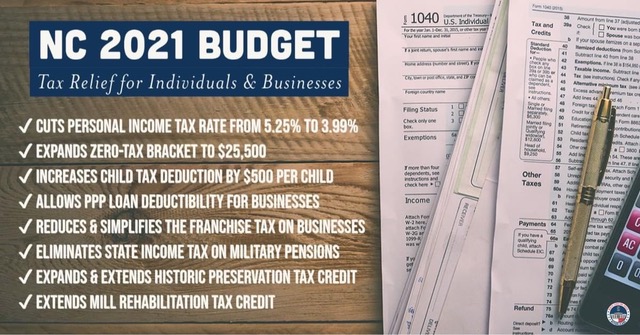
A breakdown of the tax relief for individuals and businesses.
For the first time since 2018, the state Senate, House of Representatives and governor have come to an agreement on a budget. Gov. Roy Cooper signed the $25.9 million budget on Nov. 18. The governor has vetoed previous budgets each year since taking office in 2017.
“While I believe it’s a budget of some missed opportunities and misguided policy, it’s also a budget that we desperately need at this unique time in the history of our state,” Cooper said during a press conference on Nov. 16.
Some of the things the governor likes in the budget, also appealed to legislators: expanding high-speed internet across the state so people can access education and conduct telehealth visits, funding for universities, infrastructure, and help for businesses recovering from the pandemic.
However, the governor was still not pleased that the budget did not include expanding the Medicare entitlement program, which has been a reason he gave for vetoing past budgets. “This budget fails to extend health care to the hundreds of thousands of people by expanding Medicare. The legislature directs future tax cuts to corporations rather than the middle class and lower-income.”
Rep. Karl Gillespie (R-Macon), who made the budget a priority during his campaign and subsequent first term in office, is glad to see the budget in place.
“The citizens of North Carolina need a budget,” Gillespie said. “We didn’t do it in the most timely of manner. We were doing work that should have been done in June.”
Gillespie and Sen. Kevin Corbin (R-Macon) think the key to getting the governor’s approval on this year’s budget was involving his office early in the process. Corbin said he and other legislators talked to the governor along the way and the budget went back and forth about half a dozen times in negotiating. “It was truly a more negotiating process than we’ve used in the past.”
Corbin said the budget is a daunting process when you consider a committee of 171 people are working on it. “It’s very complicated,” he said. “The budget as it is, it’s not everything that everybody wanted, but it is most things that most people wanted.”
Gillespie agreed saying, “The House didn’t get everything it wanted, the Senate didn’t get everything it wanted, and the governor didn’t get everything he wanted. It’s a compromise. It’s a bipartisan deal.”
The budget passed the second reading of the House on Nov. 18 with a 104-10 vote and in the Senate on Nov. 17 with a 41-7 vote.
“I’m very pleased this budget is going to bring some funding to our district for some much-needed projects,” Gillespie said. “There are some really good needs that are going to be met.”
Corbin said, “The big thing that I’m really happy about is teacher supplements.” All teachers across the state are getting a 5% raise, but Corbin said the rural legislators negotiated a deal for $100 million in recurring funding that will boost teachers’ salaries even more in lower-wealth counties. They used a formula that looked at the county tax base, the county tax rate and average household income. The larger counties of Mecklenburg, Wake, Guilford, Forsyth and Buncombe did not receive additional funding.
In Macon County the funding will provide a recurring annual supplement of $2,737 per teacher. “The supplements are permanent additions to teachers’ salaries,” he said. “That was a real win for Western North Carolina, a real win for rural counties in North Carolina.”
John deVille, a Franklin High School teacher and activist for increased teacher pay, thinks that the budget’s provisions for teachers leave a lot to be desired. While he appreciates the bonuses, he’s more concerned about cost-of living adjustments, which he says have lagged behind inflation for over a decade in North Carolina. He said teachers need a more dependable source of revenue to stem the mass exodus of younger teachers that he’s seeing across the state and across the nation.
“In terms of structural change for public education, it’s sorely lacking,” deVille said. “A bonus is nice, but we’re not seeing structural change right now and that’s very disappointing.”
More concerning than the lack of support now, deVille says, is the lack of options moving forward. The state is enjoying a massive influx of federal funding for COVID-19 relief that won’t last forever. The budget also calls for phasing out the corporate income tax between 2025 and 2029, which would eliminate a key source of educational funding.
“Not only are we in bad shape now, we’re also removing avenues for improvement later,” deVille said. “I don’t know where public education goes from here.”
Macon County funding
Included in the state budget is $3,359,974 for Macon County allocated as follows:
• $1.1 million for expansion of the Southwestern Community College Macon Campus. The funding will go toward STEM classroom expansion, according to Tyler Goode, SCC director of public relations.
• $50,000 for the SCC Fire Training Center.
• $713,400 toward the Nikwasi Town Cherokee Settlement.
• $100,000 for purchase of a conservation and preservation easement at the Cherokee settlement of Watauga Town.
• $300,000 to Teen/Adult Challenge of the Smokies. “We are so thankful for this support,” said Mike Barres, executive director. “This will help us to continue and help us further develop our program to work with men trapped in addiction. A great big thanks to Sen. Kevin Corbin and Rep. Karl Gillespie for their hard work in looking out for needs of the citizens in Western N.C.”
• $175,000 to the Town of Franklin for water and sewer upgrades. “There are currently two significant projects in the budget for this year for water and sewer, which will utilize ARPA (American Rescue Plan Act) funds. This new appropriation will allow us to offset some of the expenditures that come from that enterprise fund budget and could potentially allow for additional smaller improvement projects,” said Town Manager Amie Owens.
• $100,000 to the Town of Highlands for water and sewer upgrades.
• $121,574 for a Health Department grant. Emily Ritter, public information officer for the health department, said they have been told the funds can be used for communicable disease to assist with COVID-19 response.
Additionally, $1 million was allocated for Highlands and Nantahala schools, as part of the “remote schools” funding. Both are K-12 schools serving small populations. “They are expensive to operate,” said Corbin. The funding will be in addition to the education budget for Macon County Schools.
“I am very happy with the passage of this budget,” Corbin said. “We were able to get more in this budget than has ever been included for Western North Carolina.”
According to a release from Corbin’s office, the state budget sets in motion a 10-year, $16.1 billion cash infrastructure and capital plan. It also includes a tax cut that reduces the personal income tax rate to 3.99% over six years and increases the zero-tax bracket to $25,500 for married filers. It increases the child tax deduction by $500 per child and eliminates the state income tax on military pensions.
“This is a historic budget that addresses the needs of all North Carolinians,” said Gillespie. “Thanks to the legislature’s fiscal management, our state surplus allows us to invest in the right projects that propel our state forward.”
Owens said the town is appreciative of the funding it received and the support for WNC in the state budget. “Our representatives are making sure that they (the state) do not forget that the western part of the state needs to be included in the awarding of funds for infrastructure as we are an economic driver for tourism in the state.”
The Franklin Press editor Mia Overton, reporter Jake Browning and Carolina Journal/Theresa Opeka contributed to this report.