
A timber harvesting project on US Forest Service land in Macon and Jackson counties is gearing up to begin after several years of inactivity, prompting renewed resistance from a group of conservation organizations who believe many of the targeted areas should be conserved as old growth forest and habitat for the rare green salamanders found across the plateau.
The Southside Timber Project was initially proposed in 2017, with a lengthy objection process carrying on into 2018 with a final decision to move forward made in 2019. The project targets a number of forested areas in and around Cashiers, with plots targeted on Brushy Mountain, areas adjacent to Granite City and along the Round Mountain Spur of the Foothills Trail.
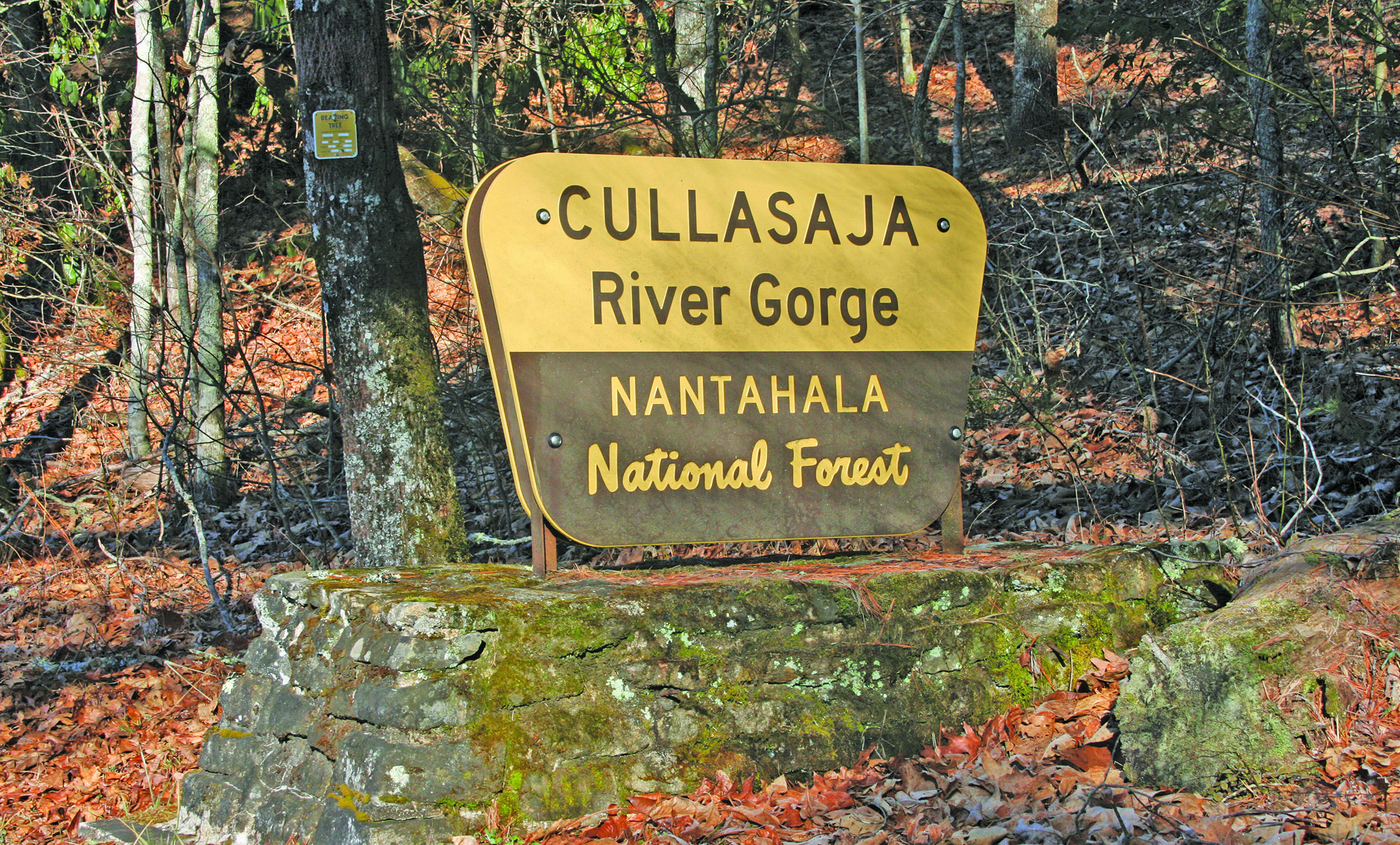
The project is beginning to move forward as proposed, according to Nantahala National Forest District Ranger Troy Waskey.
“We are starting the layout process for the timber harvest units,” Waskey said. “What we’re doing right now is two things, right off the bat – we mark the boundary of the units, and that’s already done. And then we direct practically every tree to be cut. We do that by marking which trees will remain on the landscape, and that’s what we’re working on now.”
Nicole Hayler, executive director of the Chattooga Conservancy, said these areas contain flora and fauna that are particularly vulnerable to timber harvests and has opposed these operations in these areas from the outset of the project.
“The Forest Service has chosen a really sensitive ecological area, a very rich landscape, and in that context it’s a very controversial place for an intensive timber harvest,” she said.
The Chattooga Conservancy, the Defenders of Wildlife, The Wilderness Society, MountainTrue and the Southern Environmental Law Center, along with many private residents, issued formal opposition to the project during the objection process in 2018.
The objections to the proposed harvest stem mainly from two issues the conservation organizations perceive with the plan – the existence of rare old growth trees in the targeted areas, and habitat for a species of salamanders that have seen a dramatic decline in population in recent times.
Old growth forest is a complicated matter, as specific requirements exist for defining areas as old growth. According to Hayler, at least one of the stands in question is identified as old growth by the Forest Service’s own criteria.
“We are very careful using the term ‘old growth’ – but for the purposes of the Brushy Mountain old growth, we are actually going with the Forest Service’s very strict parameters for identifying old growth. The Forest Service even acknowledges it as old growth,” she said.
Some of the trees in the targeted stands are hundreds of years old, Hayler said, which is a difficult ecosystem to restore if they are harvested.
“Existing old growth overall is very rare. It is virtually irreplaceable,” she said. “It takes hundreds of years to replace, if you ever can replace it. There are trees up there that are over a few hundred years old. The scale of old trees up there is almost mindboggling, and once you destroy them, that’s it.”
Waskey said that some of the trees in the stand on Brushy Mountain meet the definition of old growth according to the Forest Service, but the stand as a whole is not identified as an old growth area.
“The stand on Brushy Mountain has some trees in that unit that are classified by our definition for old growth, which determines if a particular stand or tree meets old growth characteristics,” Waskey said. “We do have some trees that are remnants from the past logging areas, but that’s different from designated old growth areas.”
Hayler pushed back on that assessment, saying the environmental assessment performed on the plot specifically classifies it as old growth. She pointed to the Southside Project’s environmental assessment, on page 60 of which the writers state, “Stand 35-41 near Brushy Mountain meets the operational definition for old-growth as defined in the Guidance for Conserving and Restoring Old-Growth Forest Communities on National Forests in the Southern Region.”
Waskey said the Forest Service makes an effort to leave older trees in a harvest area in general, as their existence leads to improved recovery for a harvested area.
“We always leave behind the old trees, the old snags and dead trees. We leave them because we want to leave the seed base, and they’re often spread out with branches and they aren’t really merchantable anyway,” Waskey said.
The harvesting process is a methodical one, he said, and the Forest Service takes efforts to identify older trees that can be left behind to preserve their characteristics in an ecosystem.
“If there’s an opportunity to leave behind some of these larger, older trees, which we would do anyway, we do. We don’t just turn the keys over to the contractors. The Forest Service, in a very detailed, programmatic way, goes out and marks each of these trees we’re going to leave.”
Simply leaving older trees standing after a harvest is not the same as preserving the old growth stands, though, according to Hayler.
“Old growth is not individual trees,” she said. “It is a very rare ecosystem that has some old trees in it, but it also has young trees. It is a very dynamic ecosystem that is so much more than a few old trees. There is a functioning old-growth ecosystem on top of Brushy Mountain that they should not cut, period.”
Salamander habitat
The green salamander, an elusive creature that can frequently be found in wet, rocky outcroppings as well is in the small remaining pockets of old-growth found throughout Cashiers and Highlands, could potentially be negatively impacted by these harvests as well, according to Hayler.
“It just so happens there was a population of green salamanders found in the Brushy Mountain stands,” she said. “There are two stands on Brushy Mountain, and a bit downslope of the top there is a population of green salamanders in some rocks. They are also an arboreal salamander, the only tree-dwelling arboreal salamanders east of the Rocky Mountains.”
The salamander populations identified in the Southside Project’s environmental assessment have been cordoned off by buffer zones, according to Waskey, in an effort to avoid harming their habitat.
“I think the salamander issue was pretty well disclosed, and I think our buffers will be effective from what I’ve gathered,” he said.
With the salamanders moving from rock outcroppings into the trees, though, Hayler feels that buffer zones are inadequate to protect them, effectively cutting off their means of moving between the two ecosystems.
“To draw a circle around the rock habitat in the stand downslope of the old-growth is not going to protect them,” she said.
What appears to be a breeding population of the salamanders, which have seen a population decline in recent years, is exceptionally uncommon, according to Hayler, and further assessments of the project area after the public comment period ended have found even more of the tiny creatures than initially realized.
“After the deadline to file formal objections to this project, the North Carolina Wildlife Resource Commission sent a biologist out and they found more green salamanders in the areas they surveyed,” she said. “So, first of all, the surveys the Forest Service did were inadequate. But then once the door for objecting was closed, they found more salamanders. This is obviously a dynamic population of green salamanders that was neither disclosed nor studied in the environmental assessment.
Reviewing the project
Waskey, who took on his role in the Nantahala National Forest after the planning and assessment documents were already completed, has spent months reviewing the documents associated with the Southside Project and said he still has some more work to do to be fully up to speed on the project going forward. And, while he’s open to reviewing the decisions made when the project was initially approved, he cautioned that it is not normal for the Forest Service to change these decisions without particularly compelling reasons for doing so.
“I am giving it a good, honest, open-minded look,” he said. “But, to be clear, it’s not our typical stance, and not my personal stance, to undo a decision process that was years in the making, was interdisciplinary in nature, went through an objection process and was upheld by upper leadership. I’m not going to come in and singlehandedly undo that, but I am willing to look at it and maybe there are some things we can do to implement this in a way that tilts things a little more toward working around these stands.”
The decision to proceed ultimately rests with Waskey, and Hayler said she hoped he would reconsider some of the stands they’ve identified as problematic before the landscape is changed in what she describes as an irreparable way.
“It’s important to understand that the Forest Service has complete discretion in making changes to this project,” she said. “They can say, ‘we made a mistake, the people before us didn’t look at these issues as carefully as they should have.’ They can drop these stands from the Southside Project.”