
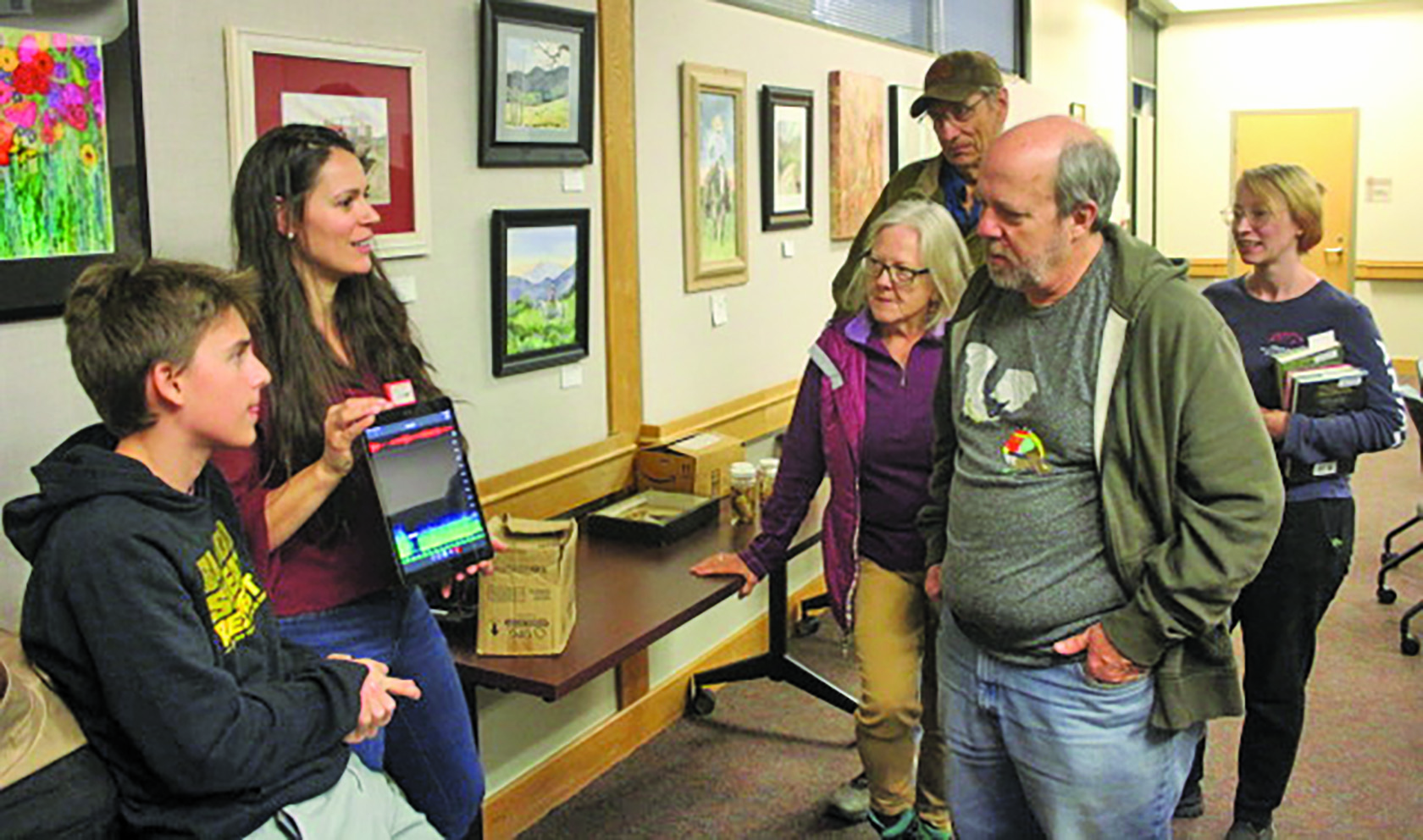
Stabilized bat populations and further research into how they live and operate was the focal point of a presentation made by Dr. Rada Petric of the Highlands Biological Station at the Macon County Public Library.
Petric is a UNC-Chapel Hill professor based at the Highlands Biological Station, which hosts 10-15 students for the entire semester. Bats are one focus of the station and the presentation was part of International Bat Week.
Petric referred to bats as “sky puppies” since some species of bats have faces resembling dogs. But unlike dogs, Petric said bats have a negative reputation that conflicts with how vital bats are to the ecosystem. Unlike Dracula, bats don’t suck human blood. And the bat species locally only eat insects.
“They can eat 1,100 mosquitoes in a single feeding session at night; they can eat their body weight in insects,” Petric said, noting that they eat pests on crops and farmlands and inadvertently contribute millions to the economy.
Not only do bats eat pests, but their excrement is rich in nutrients and acts as a fertilizer, Petric said.
Bats can live up to 35 years old. They are mammals, communicate by ultrasound, which is too high-pitched for human ears, and have similar arm structures to humans. Bats mainly live in caves and man-made structures. Almost a quarter of all living mammals are bats, Petric said, with a wide diversity of species.
Petric explained that even though bats are nocturnal, they don’t have night vision, instead using echolocation to navigate the environment in the dark. Echolocation gives bats a sound-based field of vision to help them catch prey and communicate.
North Carolina has the most bat species east of Texas, Petric said. Of the 17 species in North Carolina, 13 are local.
However, bats have faced an issue in the last 15 years, mainly from White Nose Syndrome. This fungus has led to the death of untold thousands of bats and eliminated 98% of the bat population in North Carolina. Petric said the bat population is stabilizing and expects them to rebound, as there is some fungal resistance and more conservation efforts.
Other threats to bats are windmills, not because of crashes, but because the barometric pressure caused by the tips of windmill blades causes bat lungs to burst, plus urbanization and pesticides.
Bats are mammals that give birth to one baby a year, and in some cases, twins. The baby is one-third the mother’s weight at birth. Petric says bats have delayed gestation where they can decide to become pregnant based on available resources.
“In order for [bat] populations to bounce back, it takes a really long time,” Petric said.
Two local species are in danger, Petric said. The Northern Long-eared Bat is on the federal endangered species list, and the Tricolored Bat could be soon.
“A big part of this is that we have to do the necessary research and invest in resources in order to find where these healthy populations are so we can conserve them,” Petric said.
Petric explained how they catch bats, determine their species, give them a bracelet, and let them go so they can track them.
The Highlands Research Station has six wetland project sites in Macon County since bats are attracted to water: Baliles Wetland, Tessentee Wetland, Greenway Wetland, Klatt Wetland, Cody Wetland and Bartram Wetland. At these sites, acoustic monitors record bat calls from sunset to sunrise, tracking the bat activity before and after restoration. The station also collects insect data and water quality to see how bats respond to urbanization.
So far, the station has surveyed 32 sites, recorded 100,000 bat calls, and collected around 50,000 insects, Petric said. A full study will come out shortly.
Petric promoted the BatPak project, where people can volunteer to spend one night on the Appalachian Trail and mount a tiny recorder overnight to collect noise data. The project started this year to track the habitat.
Another project is monitoring bat caves and mines. One involved feeding stations to fatten the bats so they can hibernate in the winter. A student-led study is researching the efforts of microplastics on insects and bats.
Petric offered advice for those who wish to build bat boxes. The guidance is that bat houses are 12-20 feet off the ground, avoid mounting on trees to avoid predators, give it 6-8 hours of sun, especially in the morning, have it near a water source and paint the outside a light brown to avoid overheating. Petric said the “rocket box” design is the best for attracting bats, with a 90% success rate over two years.
When asked if bats can communicate with specific bats, Petric said that Egyptian bats were found to do something akin to calling the name of particular bats but said it’s hard to get individual data to see if it’s widespread in the species.
As part of the presentation, Petric took the crowd outside in the parking lot at dusk. With bat-detecting sound and night-vision equipment, the crowd listened and looked for bats to congregate.