
County to bear cost of federal cuts, says Jackson DSS
Jackson County commissioners recently got a first look at how the Trump administration’s H.R. 1 known as the One Big Beautiful Bill could impact the county fiscally.
The information was presented to the Board at its Sept. 2 work session by Cris Weatherford, director of Jackson County Department of Social Services, as part of a routine presentation on the work DSS does.
Medicaid
Weatherford began the presentation by informing the board that approximately 12,000 Jackson County residents were currently receiving Medicaid insurance, and 2,983 new beneficiaries had been added as a result of Medicaid expansion in North Carolina with that number drawing closer to 3,000.
“We’re watching the federal reconciliation, House Bill One, because that could potentially end coverage for those new enrollees, and those 3,000 people could potentially lose their health coverage,” he said.
New work requirements will also likely make it difficult for other recipients to continue receiving coverage, Weatherford said.
However, kicking people off of Medicaid insurance rolls will not decrease the costs to counties. The bill will very likely do the opposite by scaling up the costs to counties in terms of operations at DSS.
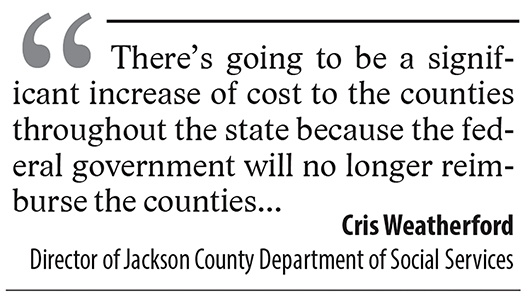
“There’s going to be a significant increase of cost to the counties throughout the state because the federal government will no longer reimburse the counties, or they reimburse the state and then the state just passes everything down to us like all the costs,” he said. “So, when the federal government switches from reimbursing us at a 75 percent rate to a 25 percent rate, we’re going to feel that because the state’s going to pass it down to us.”
Those expenses include the cost of administration such as furniture, office supplies and other equipment, the salaries of Medicaid workers including additional staff which may be needed to administer the new regulations and requirements in the bill.
On follow up Weatherford said additional administrative costs were being calculated, but the process is difficult due to several factors such as how time is coded and how much the state reimburses for certain processes.
“It is never the same amount each month; the calculation must be completed each month,” he said. “It looks like based on our initial estimates that in salaries alone the added cost to Jackson County will be around $1,000,000. There will be additional costs such as the indirect costs, etc.”
Heat and food
Additionally, there is currently no federal funding in the bill to cover the Low-income Energy Assistance Program which helps those in need with winter heating expenses, Weatherford said.
Last year DSS spent over $200,000 helping 562 Jackson residents heat their homes using LiAP funds.
Regarding Food and Nutrition Services, some of the 4,200 locals receiving food assistance through the Supplemental Nutrition Assistance Program - formerly known as food stamps - may lose that assistance.
That in turn impacts the entire county’s economy.
“It contributes around $8 million to our local economy,” Weatherford said. “I talked with one of the major grocery stores, and they estimated they get probably 20 to 40 percent of their business (from SNAP).”
It also impacts the county’s budget.
Under the Big Beautiful Bill, funding for SNAP administrative costs will shift from being federally funded to counties being required to cover 75 percent of costs in addition to 15 percent of the actual SNAP benefits. Counties are waiting for news from the state to see which expenses will be passed on to counties.
“We’re planning on having those costs basically switch places from 25 to 75 percent,” he said. “But if we had to pay 15 percent of the total cost of Food and Nutrition Service benefits this year, it would be around $2 million for Jackson County to operate that.”
Weatherford thinks the state will pitch in funds for FNS but “seriously doubt(s)” they will take up extra administrative costs for the program.
Board Chair Mark Letson asked Weatherford if counties would be receiving any direction from Raleigh regarding planning for the upcoming changes.
“With some of these, I mean, it could be very expensive, in the next year, when does it take effect, December,” Letson said.
Weatherford said some changes will begin in December and others will roll out in 2026. There is planning going on at the state level, but he is unsure what has been worked out yet.
“We worked so hard as a state to expand Medicaid that helps cover some of these individuals,” Letson said. “We just had the rug pulled out from under us.”
Weatherford explained that it was possible the state could lose expanded Medicaid altogether due to trigger laws written into the state’s expansion plan. If federal funding is cut to a certain level, Medicaid expansion will be reversed.
“They’re still working on this. I still encourage people to call and talk to the legislators and let them know what it means to them that they have these benefits,” he said. “You know, my family benefited from these when I was starting out, and that’s what they’re there for is to help us get through a patch where we need help and need to get on the other side of it. You know, we can all use that sometimes. So that’s why we’re (DSS) here.”
- Beth Lawrence
Sylva Hearld