
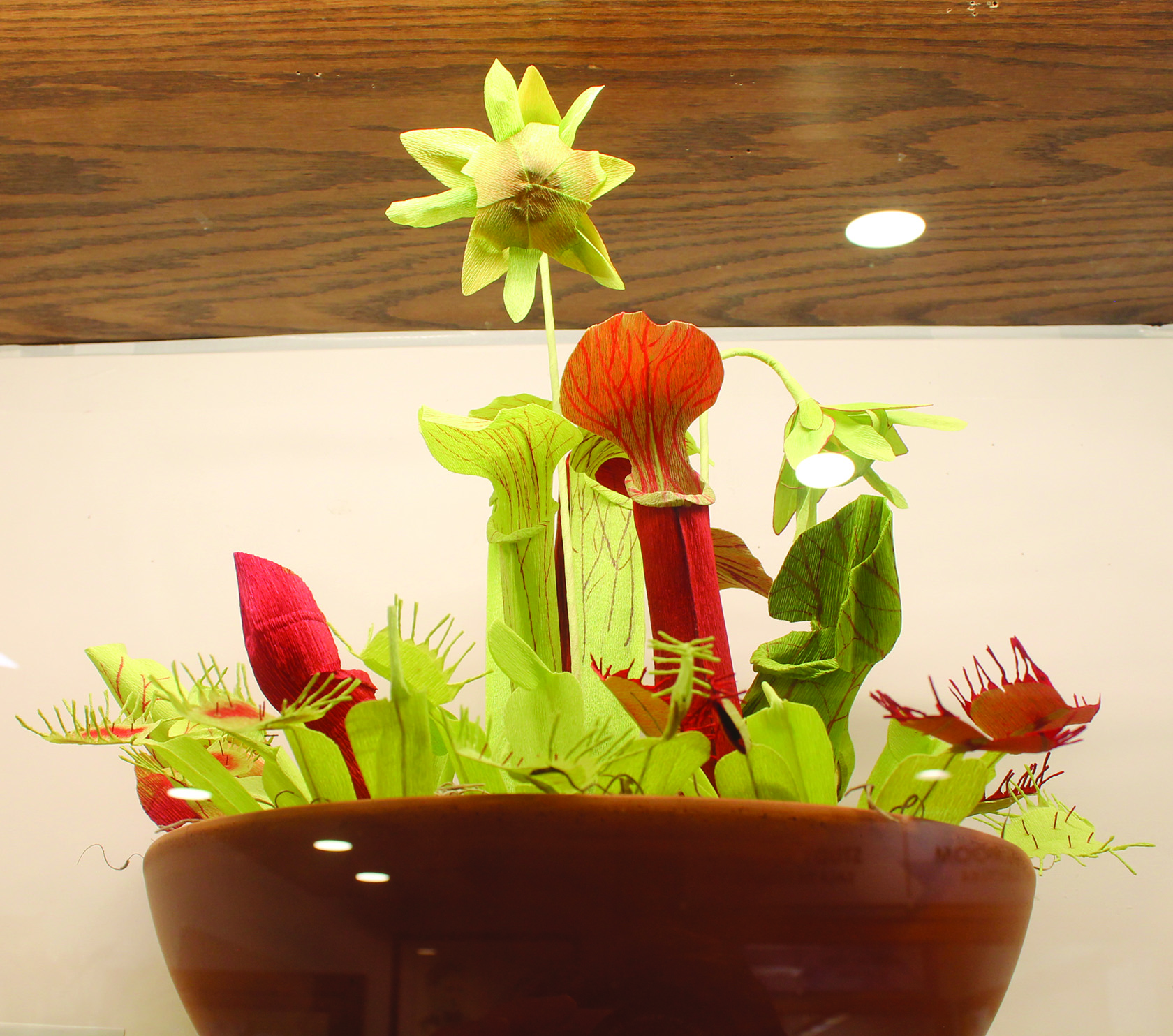
When one walks into the library for the next month, they will see what appears to be a collection of ornate flower displays. Closer observation will reveal that they’re actually delicately-made paper sculptures crafted by artist Cynthia Woodsong.
“What I do, I call them paper botanicals,” she said. “They’re replicas of native plants, made from paper. I make them as botanically accurate as possinle, to scale. I match the color of the petal, the leaves… I match what the real thing is. If you put it in a garden, you might mistake it for the real thing. Then you go ‘wait a minute – that’s made of paper.’”
The art pieces are constructed by using several colors of Japanese hand-made paper alongside German and Italian crepe paper, cutting and gluing until she gets them in the right, delicate shapes.
On Friday afternoon, Woodsong said she was enjoying her afternoon off after two art classes earlier in the week at the Highlands Biological Station as well as putting up her new exhibit at the library.
“I’m happy as a clam,” she said. “I’m just sitting here dissecting a flower.”
Woodsong normally works with the North Carolina Botanical Garden in Chapel Hill, but came to Highlands for the week to do a series of pro-bono classes, with the money people paid going toward a fundraiser for the Highlands Biological Station, which will benefit the botanical gardens through the HBS Advancement Fund at Western Carolina University.
James Costa, Executive Director of HBS, said the money will go toward “new plantings, signs and labels, trail upkeep, hemlock tree treatments, and more.”
The classes went splendidly – some of the participants had never done anything creative before, and said they “didn’t think of themselves as creative,” she said. They spent several hours on Tuesday, May 14 and Thursday, May 16 learning to make the artwork.
In the classes, they made paper replicas of two flowers: on Tuesday they made a Pitcher Plant and on Thursday a Turk’s Cap Lily. The classes are a “mix of art and science,” as while doing the art, Woodsong also teaches them about the botanical facts of the plants, including their habitat and what pollenates them, among other details.
She said there was a long heritage of paper art dating back to the beginning of paper being made at all. “It was one of the first things done with paper, when it was first thought up,” she said.
In the U.S. in the 1950s and ‘60s, she said paper flower art was a big trend – her own grandmother did it as well. She said many people associate the artform with “big fluffy things” that might be seen at weddings, but her own art is comprised of flowers that she tries to make as realistic as possible.
Her exhibit will be on display at the library until the end of June. There are a few flowers mounted on the library’s sign at the front desk and several other exhibits in glass encasements at the wall at the front of the lobby. She said the exhibits at the library are more complex than the flowers she taught in the classes.
“I just used to make pretty things,” she said. “Like roses and daffodils. I still like to make those things, but I like to focus on things not usually seen made with paper. Some of them, you have to hike a long way to see them. So this is a novel way to experience the plants.”
In general, Woodsong feels she’s carved out a unique niche for herself in the art world, particularly as she’s been working in Western North Carolina the past several years, as the area is home to many varieties of flowers she can draw inspiration from.
“I learned the basic construction, and I put my mind to making more,” she said. “You can find online how to make a rose, but never how to make an Oconee bell. It’s a beautiful species. They bloom here. I applied my techniques to make that.”
She said she goes through meticulous processes to make her work as detailed as it can be.
“I included parts no one knows is in there,” she said. “No one can see it. If a botanist took it apart, they could see it and say ‘oh, you included that.’ If you lift the petal up on a trust lily, and look underneath, you can see it, only on my paper flowers, you’re not going to hurt it.”
Woodsong said she’s looking forward to coming back to Highlands and working with the Highlands Biological Station in the future.
“We’re starting to develop plans,” she said. “They didn’t know the full range of what I could offer.”