
Funding included for water clarifier tank, Mirror Lake dredging
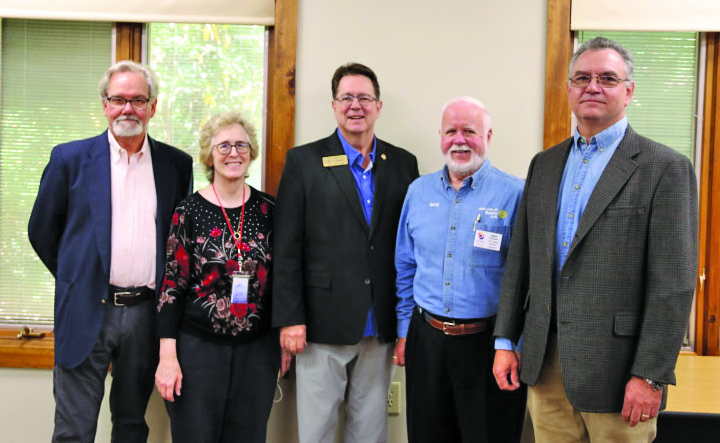
Highlands Mayor Patrick Taylor called on his friends in Raleigh to come speak at his September “Coffee with the Mayor” program at Hudson Library on Friday.
North Carolina Sen. Kevin Corbin (R-Macon) and Rep. Karl Gillespie (R-Macon) brought with them some good news in regard to the recently passed state budget. Two of Highlands most pressing issues were addressed with money provided by the state.
“When the state budget passed last week I went to town manager Josh Ward’s office and him and I combed over it to see if Highlands had any projects get funded,” Taylor said. “We were very happy to see $5 million in the budget for our new clarifier tank at the water treatment plant, and initially we were a little disappointed that there was no money for the dredging project for Mirror Lake.”
Taylor went to the town board of commissioners meeting that night and informed the board that the dredging project was not funded in the 2024-25 budget at the state level, only to be corrected the following morning.
“Low and behold, the following morning we were informed that there was money in there for dredging Mirror Lake, it just wasn’t under the line items where we would expect to see it,” Taylor said. “So, we are thrilled that both of those projects received funding in Raleigh.”
The dredging project is also expected to cost $5 million.
Gillespie praised Taylor and the town staff for their ability to communicate through the budget process. Gillespie read an email from Taylor explaining the importance of dredging of Mirror Lake to Highlands’ environment and to the town’s water system.
“The tone of the email was what really stood out to me,” Gillespie said. “There was no demand, there was no ‘we have to have this right now,’ Pat simply laid out the need for dredging funding and asked Kevin and I to support that. We both got behind that project and we were happy to see it make the final cut under the NC Division of Environmental Quality budget.”
Corbin explained the budget process and how much work it takes to get anything approved in Raleigh. He asked if anyone in the room had ever served on a committee at their church, homeowners association, or civic organization.
“It’s hard to get five or seven people to agree on anything, let alone 171 people from all across this state,” Corbin said. “In reality, that is what we have in the legislature, a 171-person committee, 120 representatives, 50 senators and one governor. So, during the budget process we really have to work together and we have to work with our local leaders to get things accomplished. Fortunately, Karl and I have a great relationship, we have been friends for many years, and we use that to our advantage.”
Corbin, who serves on the Senate health and human services committee and the appropriations committee, pointed out that he and Gillespie have increased the amount of “special projects” funding that has come into Western North Carolina each year since Gillespie was elected in 2020.
“We have to advocate for our constituents and also for what makes our district unique,” Gillespie , who serves as House Majority Whip, said. “For me, what makes my four-county district unique is our environment and the industries associated with that, and also our agricultural assets. Agriculture is still North Carolina’s number one economic driver and its vitally important. That is why I asked to be on those two committees at the state level and I was fortunate that Speaker (Tim) Moore agreed to put me on those.”
Both Corbin and Gillespie talked about how important it is to have local leaders who can convey their town or county’s needs effectively.
“Kevin and I spend a great deal of time within our districts talking to people and trying to understand exactly what the most pressing issues are,” Gillespie said. “We both go to bat for our towns and counties when we’re in Raleigh and as the state continues to grow and become increasingly urban, that is going to be more important every year.”
Highlands Chamber of Commerce Execute Director Kaye McHan asked the legislators about that growth and how the state can help sustain the current business climate by promoting affordable housing initiatives and affordable childcare.
“North Carolina is currently the ninth most populous state in the country and we are continuing to grow,” Corbin said. “In my eight-county district every county has seen population growth over the past five years, with the exception of Graham County. With that said, the urban counties around Charlotte, Raleigh, the triad, are growing at a much faster rate than we are in Western North Carolina. What that means is they are going to get more and more representation in Raleigh.”
Corbin noted that Charlotte’s metro area is currently represented by two Senators and 17 representatives, and that number may grow when the state undergoes redistricting later this year.
“Karl and I work hard to make sure everyone knows that Western North Carolina doesn’t end at Asheville,” Corbin said. “And going forward that job is only going to get more difficult as the urban areas add representatives and the rural areas lose them.”
Corbin added that North Carolina’s population growth can be seen in two tax adjustments that the legislature has made in recent years.
“We have lowered the personal income tax every budget cycle recently and we are lowering it again in this budget,” Corbin said. “Among states that have income tax, ours is now among the lowest, and that benefits working people. We have also lowered the corporate tax rate every year and are continuing to do so. That makes our state more attractive to major companies that want to move here, and thus increases business investment in our state.”
While the state does not have any specific plan in place to increase workforce housing, Corbin said the state has taken steps to decrease the red tape that local governments have to deal with to support such projects.
“We continuously go back and look at our laws in Raleigh and make sure they aren’t holding up towns and counties from doing things they need to do,” Corbin said. “If Highlands, or Franklin, or anywhere else needs workforce housing we want them to be able to take action and move those projects forward. Karl and I will help facilitate those projects any way we can in Raleigh.”